 Zum Inhalt springen







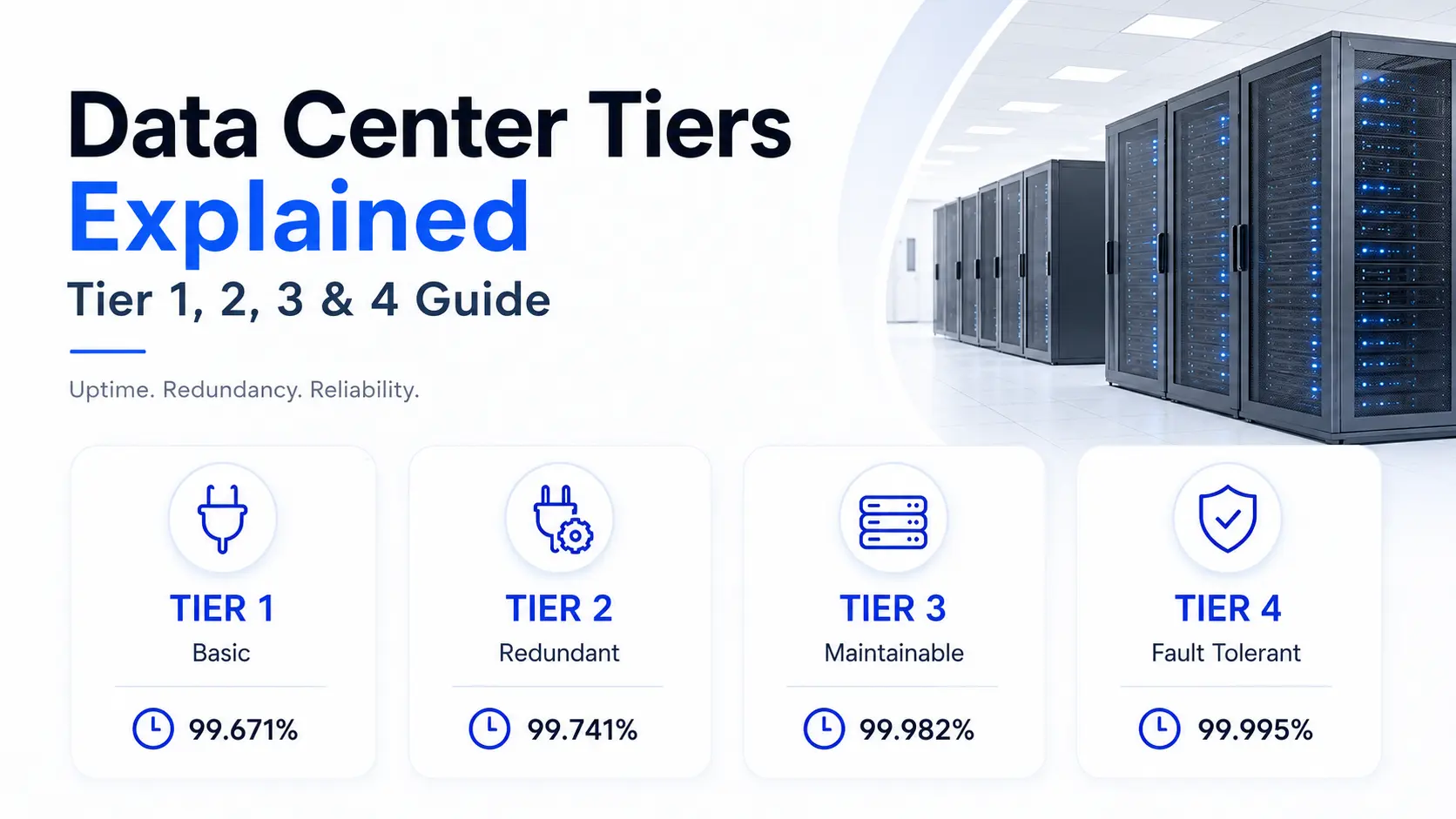
Data center tiers are a standardized classification system, created by the Uptime Institute, that defines a facility’s expected availability, redundancy model, and fault tolerance across four levels. Tier I provides basic infrastructure with no redundancy and 99.671% uptime. Tier II adds partial backup components at 99.741% uptime. Tier III delivers concurrent maintainability and 99.982% uptime. Tier IV offers complete fault tolerance and 99.995% uptime, allowing no more than 26.3 minutes of downtime per year.
Every colocation contract, dedicated server purchase, and bare metal deployment connects back to one question: does the facility running your infrastructure actually match the reliability your business needs? A provider can advertise a tier number in any sales deck. The number itself means nothing without understanding the engineering behind it.
This guide covers each tier in full technical detail, the real difference between concurrent maintainability and fault tolerance, how the Uptime Institute Tier Standard relates to ANSI/TIA-942 Ratings, which compliance frameworks map to which tier, and how to choose the right tier for your actual workload rather than a sales pitch.
The Uptime Institute Tier Standard: Where It Started
The Uptime Institute introduced the tier classification system in 1995 under the title “Tier Classifications Define Site Infrastructure Performance.” The system addresses one fundamental question: what happens to your infrastructure when something goes wrong, whether that means a planned maintenance window, an unexpected component failure, or a regional power event.
The standard evaluates data center infrastructure across two components. The first is topology, which covers the physical design of power and cooling systems, the number of distribution paths, and the redundancy model built into the facility. The second is operational sustainability, which covers the behaviors, staffing practices, and risk management procedures that determine whether the facility actually performs at its designed tier level over time.
The four tiers are progressive. Each tier includes all the requirements of the tiers below it. Moving from Tier I to Tier IV adds redundancy, extends uptime, and significantly raises both capital and operational costs. A higher tier does not automatically make a facility “better” for every business, it means the facility is built to survive a more demanding set of failure scenarios.
Certification under the Uptime Institute standard operates at three distinct levels: Tier Certified Design Documents (the architectural plans meet tier requirements), Tier Certified Constructed Facility (the built facility has been independently assessed), and Tier Certified Operational Sustainability (ongoing operational practices have been audited and rated Gold, Silver, or Bronze). A facility can hold design certification without ever being assessed as built. This distinction matters every time a provider makes a tier claim.

Tier 1 Data Center: Basic Infrastructure
A Tier 1 data center is the most fundamental level of infrastructure the Uptime Institute defines. It operates from a single, non-redundant path for both power and cooling. There are no backup components for any critical system. Any maintenance activity, planned or unplanned, requires a full or partial shutdown of the facility.
Tier 1 Technical Specifications
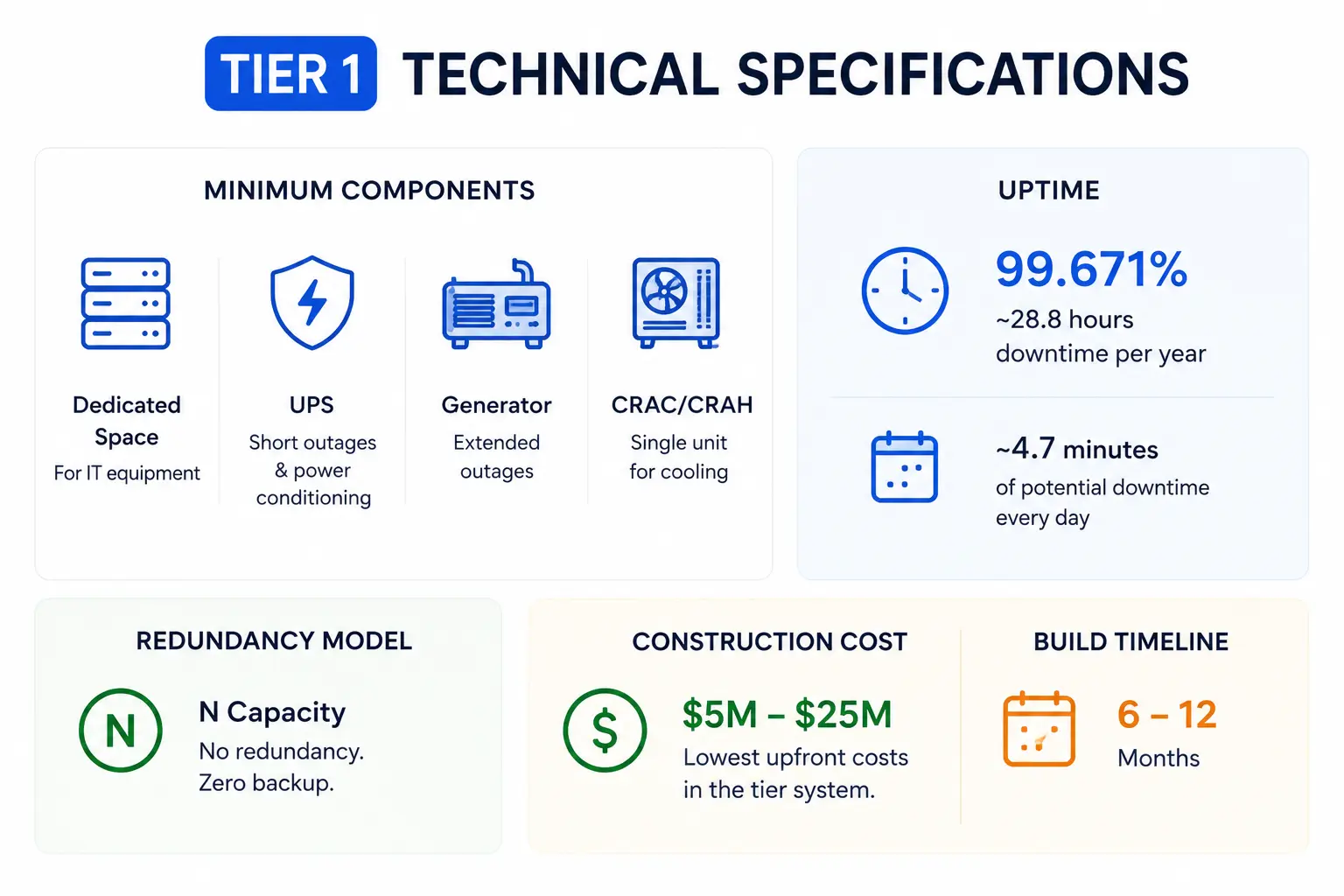
The minimum components a Tier 1 facility must include are: dedicated space for IT equipment, an uninterruptible power supply (UPS) for short outages and power conditioning, an engine generator for extended outages, and a single CRAC or CRAH unit for cooling.
The expected uptime for a Tier 1 facility is 99.671%, which translates to approximately 28.8 hours of potential downtime per year. Spread across a calendar year, that is roughly 4.7 minutes of potential downtime every day. There is no redundancy model: the facility operates at N capacity with zero backup.
Construction costs for a Tier 1 facility typically run between $5 million and $25 million, with build timelines of six to twelve months. These are the lowest upfront costs in the tier classification system, and they reflect the infrastructure simplicity of the design.
Business Impact of Tier 1 Downtime
Twenty-eight-plus hours of potential downtime per year carries significant business consequences for any revenue-generating workload. Research from the Information Technology Industry Council documented enterprise downtime costs ranging from $300,000 to more than $5 million per hour for large organizations, not counting legal fees or regulatory penalties.
For context, a business experiencing the maximum Tier 1 downtime allowance against a conservative downtime cost of $300,000 per hour would face potential losses of $8.6 million annually from infrastructure failures alone.
Tier 1 infrastructure serves a specific, limited set of use cases. Development and testing environments where downtime is tolerable and not revenue-connected are reasonable candidates. Internal lab infrastructure, archival storage, and startup offices with non-critical systems can operate here. Any production workload with real users, revenue, or regulatory obligations does not belong in a Tier 1 facility.
Tier 1 at a Glance
| Spezifikation | Tier 1 |
|---|---|
| Expected uptime | 99.671% |
| Annual downtime allowance | ~28.8 hours |
| Power and cooling paths | Single |
| Redundancy model | None (N) |
| Concurrent maintainability | Nein |
| Fault tolerance | Nein |
| Estimated build cost | $5M–$25M |
| Best suited for | Dev/test, internal labs, archives |

Tier 2 Data Center: Redundant Components Added
A Tier 2 data center builds on Tier 1 by adding partial redundancy for power and cooling components. The critical distinction from Tier 1 is the addition of backup components. The critical limitation shared with Tier 1 is that both still rely on a single distribution path for power and cooling.
Tier 2 Technical Specifications
The backup components added at Tier 2 include additional UPS modules, chillers, pumps, and energy generators. These components operate in N+1 redundancy for the components themselves, meaning if one component fails, a backup exists to take its place.
The single distribution path remains. If the path itself fails or requires maintenance, the IT equipment it serves goes offline regardless of how many backup components sit alongside it. This is the architectural constraint that separates Tier 2 from Tier 3.
The expected uptime for a Tier 2 facility is 99.741%, which allows approximately 22 hours of downtime per year. Construction costs typically run between $20 million and $60 million, with build timelines similar to Tier 1 in layout complexity since dual distribution paths are not yet required.
The Tier 2 Ceiling Problem
Tier 2 often functions as a stepping stone rather than a destination. Businesses start here because the cost is manageable and the uptime improvement over Tier 1 is meaningful. The problem emerges when customer SLAs or regulatory requirements push uptime expectations toward 99.9% or above.
Retrofitting a Tier 2 facility to Tier 3 requires fundamental changes to the distribution path architecture, not just adding more components. The layout itself must support multiple independent paths, which typically cannot be achieved through modification of an existing Tier 2 design. Organizations that plan to grow into regulated industries, enterprise SLAs, or high-availability production workloads should treat Tier 2 as a transitional position, not a permanent infrastructure strategy.
Tier 2 at a Glance
| Spezifikation | Tier 2 |
|---|---|
| Expected uptime | 99.741% |
| Annual downtime allowance | ~22 hours |
| Power and cooling paths | Single (same as Tier 1) |
| Redundancy model | Partial N+1 (components only) |
| Concurrent maintainability | Nein |
| Fault tolerance | Nein |
| Estimated build cost | $20M–$60M |
| Best suited for | SMBs, internal apps, non-critical workloads |

Tier 3 Data Center: Concurrent Maintainability
Tier 3 is the most widely built commercial data center standard in the world, and the design change from Tier 2 to Tier 3 is the most significant operational shift in the entire tier classification system. The defining concept is concurrent maintainability.
Tier 3 Technical Specifications
A Tier 3 facility provides multiple independent distribution paths for both power and cooling, with N+1 redundancy across all systems. Only one distribution path is active at any time; the others remain available as backup. Every component in the facility, including UPS systems, cooling units, generators, and cabling, can be maintained, repaired, or replaced without taking the IT load offline.
The expected uptime is 99.982%, which allows approximately 1.6 hours of downtime per year. This figure represents a 93% reduction in annual downtime compared to Tier 2. Tier 3 facilities must also be able to sustain operations for a minimum of 72 hours following a local or regional power outage.
Construction costs range from $50 million to $250 million, with build timelines of twelve to eighteen months. The additional infrastructure complexity, dual distribution path routing, N+1 component sizing across all systems, and the engineering overhead of path independence, drives cost well above Tier 2.
Understanding N+1 Redundancy in a Tier 3 Facility
N represents the capacity required to support the full IT load. The additional +1 is one extra component held in backup. A practical example: if a Tier 3 facility needs three cooling units at full IT load (N=3), it operates with four units total. One can fail or be taken offline for scheduled maintenance without any impact on the IT environment it serves.
This model applies across all critical systems in a Tier 3 facility, not just cooling. Power distribution, UPS capacity, generator capacity, and cabling all carry the +1 buffer. Tier 2 applies this same model to components but not to distribution paths. Tier 3 extends it to both.
The Concurrent Maintainability Advantage
The operational impact of concurrent maintainability is significant. Engineers can service power infrastructure during normal business hours without requiring maintenance windows or customer notifications. Planned work, including UPS battery replacement, generator servicing, and cooling unit rotation, happens without any impact on hosted workloads.
The roughly 1.6 hours of annual downtime that Tier 3 allows typically comes from simultaneous or cascading failures, not from routine maintenance activities. A single component failure in a well-run Tier 3 facility triggers the N+1 backup without customer-visible impact. The risk window is the period between a first failure and the completion of repair before a second failure could affect the system.
Tier 3 is also the minimum tier for most enterprise compliance frameworks. SOC 2 Type II, PCI DSS, HIPAA, and ISO 27001 requirements can all be met in a Tier 3 facility when appropriate operational controls accompany the physical infrastructure.
Tier 3 at a Glance
| Spezifikation | Tier 3 |
|---|---|
| Expected uptime | 99.982% |
| Annual downtime allowance | ~1.6 hours |
| Power and cooling paths | Multiple independent (one active at a time) |
| Redundancy model | Full N+1 |
| Concurrent maintainability | Ja |
| Fault tolerance | Nein |
| Power outage capacity | 72-hour minimum |
| Estimated build cost | $50M–$250M |
| Best suited for | Enterprise production, SaaS, e-commerce, regulated industries |
Tier 4 Data Center: Complete Fault Tolerance
Tier 4 represents the highest classification level under the Uptime Institute standard. The fundamental design difference from Tier 3 is not redundancy quantity but system behavior during a failure: all distribution paths are active at the same time, not just available on standby.
Tier 4 Technical Specifications
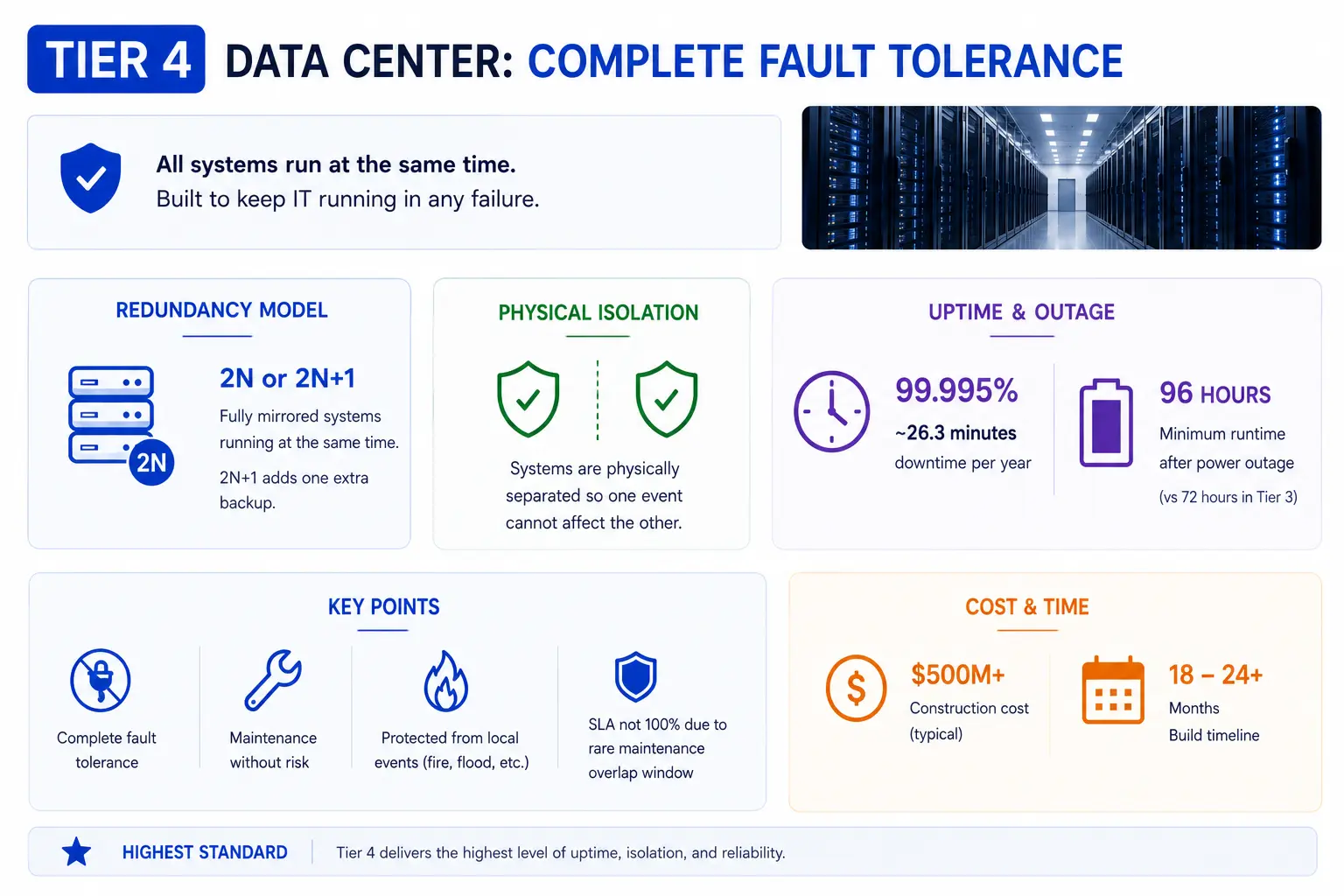
A Tier 4 facility operates on 2N or 2N+1 redundancy across every critical system. The 2N model means the facility maintains a fully mirrored, independent system on standby for every component and distribution path. 2N+1 adds one additional backup component on top of the doubled capacity.
Physical isolation is a required element of Tier 4 design. Redundant components must be physically separated to prevent a single local event, a fire in one electrical room, a flood in one cooling zone, from compromising both systems at once. The two independent systems must be able to fail independently.
The expected uptime is 99.995%, which allows approximately 26.3 minutes of downtime per year. The reason Tier 4 SLAs do not guarantee 100% uptime is that a component can encounter a problem during the maintenance of its redundant counterpart, creating a brief window of single-system operation.
A Tier 4 facility must sustain operations for a minimum of 96 hours following a local or regional power outage, compared to 72 hours at Tier 3. The power source must operate independently from any external connection during this period.
Construction costs exceed $500 million for most Tier 4 builds, with timelines of eighteen to twenty-four months or longer. These costs reflect the engineering complexity of full fault tolerance across every infrastructure domain.
Fault Tolerance vs. Concurrent Maintainability
This distinction gets blurred by most sources, and it matters for procurement decisions.
Concurrent maintainability (Tier 3) means a facility can perform maintenance without causing downtime. An unplanned failure, however, removes one layer of redundancy and creates a period of risk until the failed component is repaired. A second failure during this window can cause an outage.
Fault tolerance (Tier 4) means the system continues operating through any single unplanned failure without creating a risk window. The 2N design ensures that even after one complete system fails, a fully independent second system carries the load without the first being needed.
The operational distinction is this: Tier 3 protects against planned maintenance downtime. Tier 4 protects against both planned maintenance downtime and single unplanned failures.
The Tier 4 Cost Reality
Tier 4 colocation commands a 15 to 30 percent power rate premium over comparable Tier 3 facilities. Over a three to five year contract term, this premium compounds into significant total cost differential. For a business consuming 100 kW of colocation power at $100/kW per month in a Tier 3 facility ($120,000/year), the same footprint in a Tier 4 facility at 20% premium adds $24,000 to $36,000 per year with no performance benefit for workloads that do not require continuous operation through dual simultaneous failures.
The broader market reflects this economics reality. The colocation industry shifted from building predominantly to Tier 4 standards around 2010 to 2012. Today, Tier 3 is the commercial production standard and most global enterprise platforms, including many of the world’s largest SaaS companies, operate on Tier 3 infrastructure.
Tier 4 at a Glance
| Spezifikation | Tier 4 |
|---|---|
| Expected uptime | 99.995% |
| Annual downtime allowance | ~26.3 minutes |
| Power and cooling paths | Multiple, all active at once |
| Redundancy model | 2N or 2N+1 |
| Concurrent maintainability | Ja |
| Fault tolerance | Voll |
| Power outage capacity | 96-hour minimum |
| Estimated build cost | $500M+ |
| Best suited for | Mission-critical enterprise, government, global finance, healthcare clinical |
Tier 1 vs Tier 2 vs Tier 3 vs Tier 4: Side-by-Side Comparison
The table below gives a complete comparison across every specification that matters for infrastructure and procurement decisions.
| Spezifikation | Tier 1 | Tier 2 | Tier 3 | Tier 4 |
|---|---|---|---|---|
| Expected uptime | 99.671% | 99.741% | 99.982% | 99.995% |
| Annual downtime | ~28.8 hours | ~22 hours | ~1.6 hours | ~26.3 minutes |
| Power/cooling paths | Single | Single | Multiple (1 active) | Multiple (all active) |
| Redundancy model | None (N) | Partial N+1 | Full N+1 | 2N or 2N+1 |
| Concurrent maintainability | Nein | Nein | Ja | Ja |
| Fault tolerance | Nein | Nein | Nein | Ja |
| Power outage operation | Basic UPS | UPS + generator | 72 hours | 96 hours |
| Build cost (estimate) | $5M–$25M | $20M–$60M | $50M–$250M | $500M+ |
| Colocation price vs. Tier 3 | Below | Below | Standard | +15–30% |
| SOC 2 Typ II | Nein | Conditional | Ja | Ja |
| PCI DSS | Nein | Conditional | Ja | Ja |
| HIPAA | Nein | Nein | Ja | Ja |
| Best business fit | Dev/test | SMB internal | Enterprise production | Mission-critical |
The most operationally significant jump in this table is the move from Tier 2 to Tier 3. This transition introduces concurrent maintainability, cuts annual downtime from 22 hours to 1.6 hours, and opens the door to enterprise compliance frameworks. The jump from Tier 3 to Tier 4 extends fault tolerance, but the production uptime difference is roughly 80 minutes per year, which for most workloads does not justify the 15 to 30 percent cost premium.
Uptime Institute Tiers vs. ANSI/TIA-942 Ratings: The Distinction Most Buyers Miss
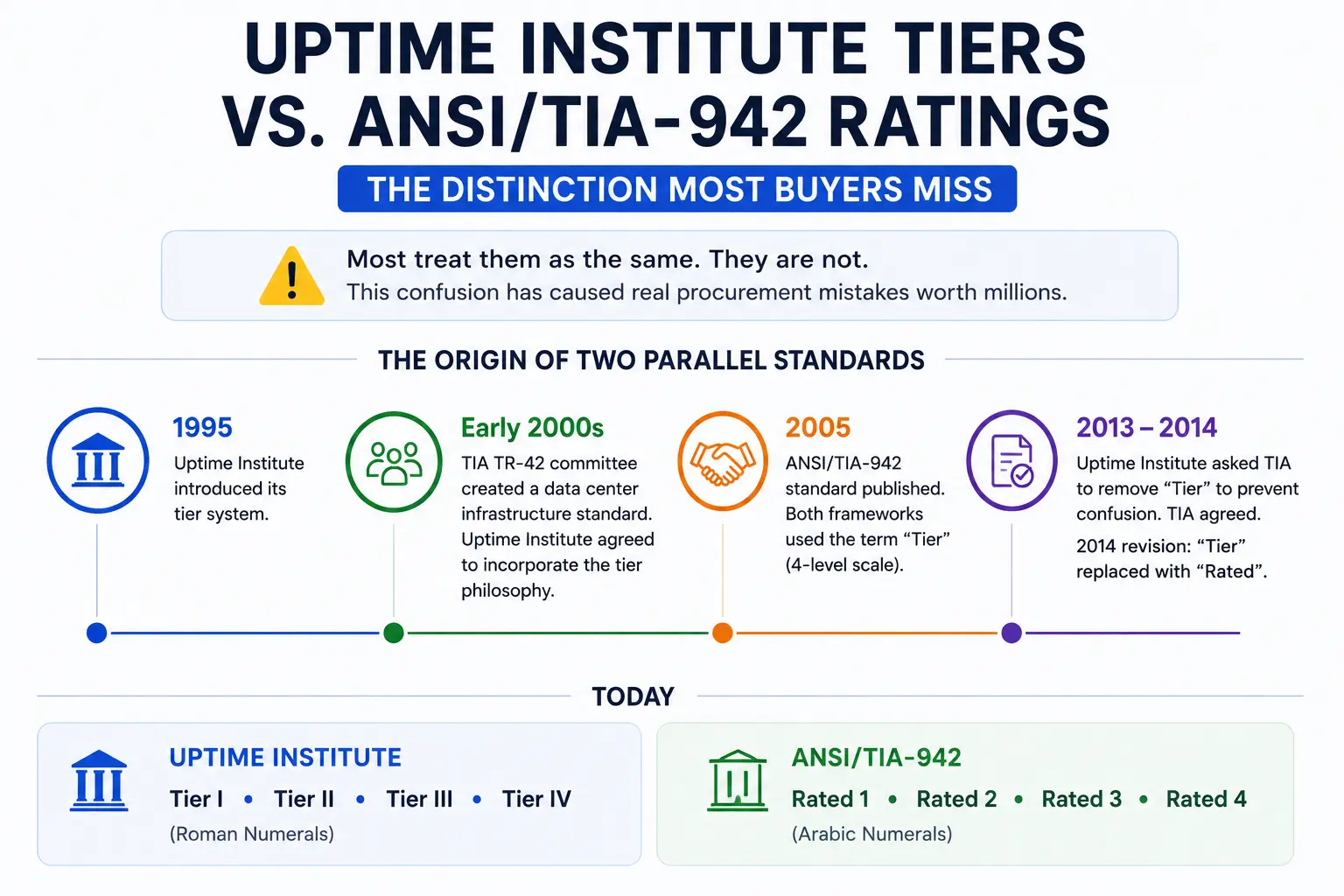
Most articles covering data center tiers treat Uptime Institute Tiers and ANSI/TIA-942 Ratings as interchangeable. They are not, and the confusion has caused real procurement mistakes worth millions of dollars.
The Origin of Two Parallel Standards
The Uptime Institute introduced its tier system in 1995. In the early 2000s, the TIA TR-42 committee decided to create a telecommunications infrastructure standard for data centers and, with Uptime Institute’s agreement, incorporated the tier philosophy into the ANSI/TIA-942 standard published in 2005. Both frameworks initially used the term “Tier” with a four-level scale.
In 2013, the Uptime Institute approached TIA requesting that TIA remove the word “Tier” from its standard to prevent market confusion. TIA agreed, and the 2014 revision of ANSI/TIA-942 replaced “Tier” with “Rated.” Today, Uptime Institute uses Tier I through Tier IV (Roman numerals). ANSI/TIA-942 uses Rated 1 through Rated 4 (Arabic numerals).
Key Differences in Scope
The Uptime Institute Tier Standard primarily addresses electrical and mechanical systems: power distribution paths, UPS systems, generators, and cooling infrastructure. It is goal-oriented and design-flexible; it defines what a facility must achieve rather than prescribing specific technology choices.
ANSI/TIA-942 evaluates facilities across four full infrastructure domains: Telecommunications (cabling and pathways), Architectural (physical structure and physical security), Mechanical (cooling and fire suppression), and Electrical (power systems). A facility can achieve different ratings in different domains under TIA-942, a nuance the Uptime Institute framework does not support. A data center might be Rated 3 for Electrical and Mechanical but Rated 2 for Telecommunications.
Certification Process Differences
Uptime Institute administers its own certification: Uptime Institute auditors conduct the assessment and issue the certificate. This creates a direct commercial relationship between the certifying body and the facility operator. Certification exists at three stages: design documents, constructed facility, and operational sustainability.
TIA-942 certification is administered by independent auditing organizations accredited by TIA under its official accreditation scheme (Certac is the accreditation body). This separation between the standards development organization (TIA), the accreditation body (Certac), and the conformity assessment bodies (auditors like EPI) follows the ISO model for avoiding conflicts of interest.
A provider claiming “Tier 3 certified” should be able to produce an actual Uptime Institute certificate with a specific certification type and date. Without that document, the claim is unverified.
ISO/IEC 22237: A Third Framework
For organizations operating under international compliance requirements, ISO/IEC 22237 provides a parallel classification system covering data center availability, security, and energy efficiency. Published by the International Organization for Standardization, this framework applies globally and addresses building construction, power distribution, cooling, and physical security in a way that integrates with ISO 27001 and related information security standards. In 2026, ISO/IEC 22237 is the framework of choice for multinational organizations that need to demonstrate infrastructure resilience to regulators in multiple jurisdictions.
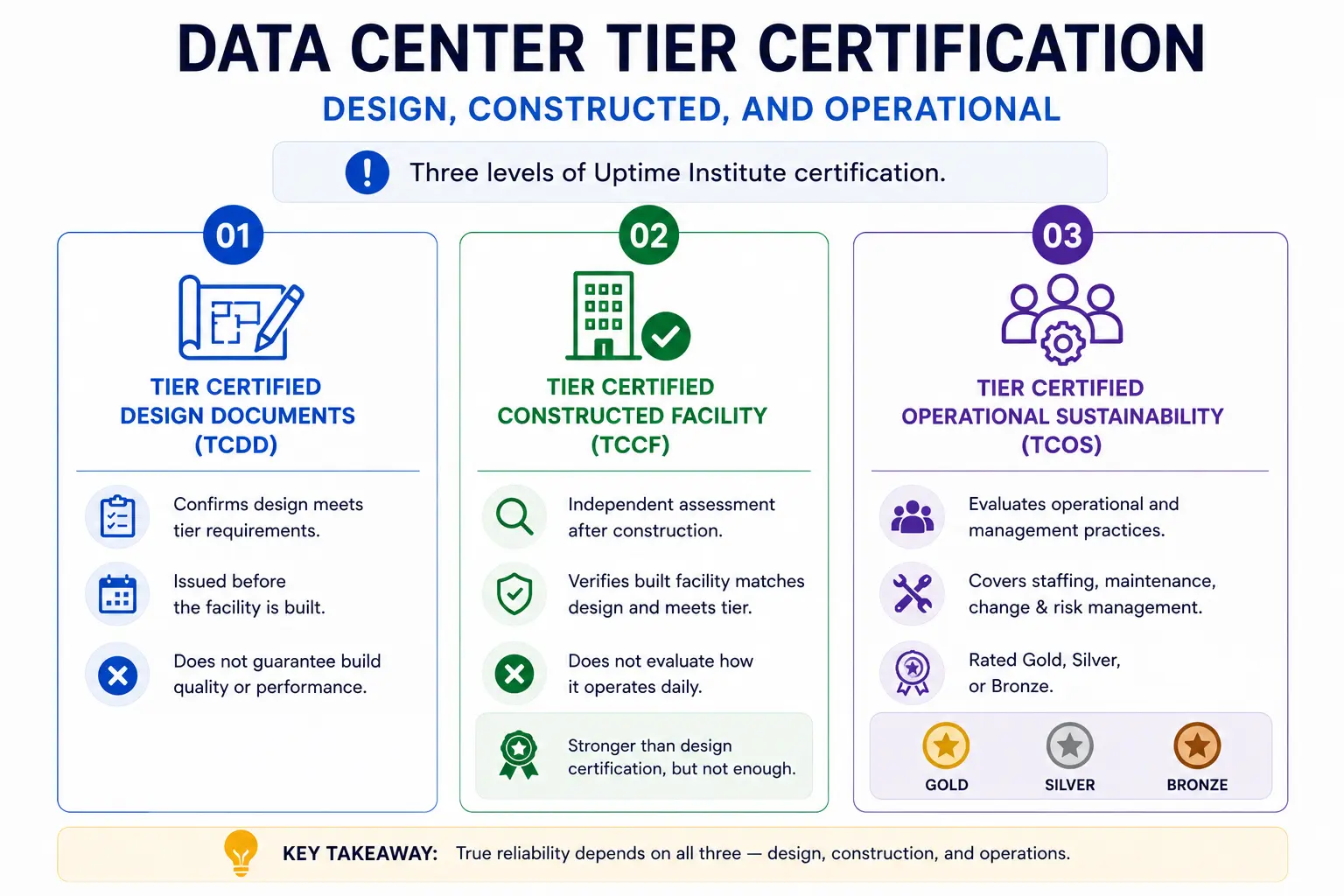
Data Center Tier Certification: Design, Constructed, and Operational
Understanding the three levels of Uptime Institute certification prevents the most common procurement mistake in the colocation market.
Tier Certified Design Documents (TCDD)
Design certification confirms that the architectural and engineering plans for a facility meet the requirements of the specified tier. This certification is issued before the facility is built. It says nothing about the quality of construction, the accuracy of execution, or the operational practices of the completed facility. A facility can claim TCDD certification for Tier 4 and then be built in ways that do not meet Tier 4 requirements.
Tier Certified Constructed Facility (TCCF)
Constructed facility certification requires an independent assessment of the physical facility after construction. Uptime Institute auditors verify that what was built matches the certified design and meets the tier requirements in physical form. This is a meaningfully stronger credential than design certification alone, but it still does not address how the facility operates day to day.
Tier Certified Operational Sustainability (TCOS)
Operational sustainability certification, introduced in 2013, addresses the behavioral and management practices of a facility. It covers staffing models, maintenance procedures, change management processes, and risk management frameworks. Facilities receive Gold, Silver, or Bronze ratings within the TCOS program based on the quality of their operational practices.
This certification matters because an operationally neglected Tier 4 facility can underperform a well-operated Tier 3 facility in real-world uptime. Design determines potential; operations determine outcomes.
Before signing any colocation contract, ask specifically which certification level the provider holds, request the actual certificate document, and verify the certification date. Certifications lapse and must be renewed. A TCCF certificate from 2018 in a facility that has since undergone significant infrastructure changes may not reflect current conditions.
Compliance Frameworks and Data Center Tier Requirements
Regulatory compliance requirements often drive tier selection for businesses in healthcare, finance, and e-commerce. The table below maps common frameworks to minimum tier requirements.
| Compliance Framework | Minimum Tier | Key Consideration |
|---|---|---|
| SOC 2 Typ II | Tier 3 | Physical infrastructure must combine with operational controls |
| PCI DSS | Tier 3 | Payment cardholder data environments |
| HIPAA | Tier 3 | Healthcare data; operational controls required alongside physical |
| ISO 27001 | Tier 3 | Physical security and availability requirements |
| FedRAMP Moderate | Tier 3 | US Federal cloud systems |
| FedRAMP High | Tier 4 | Mission-critical federal applications |
| FINRA-regulated trading | Tier 4 preferred | High-frequency and mission-critical financial systems |
| GDPR (EU data residency) | Tier 3 minimum | Data residency tied to facility location, not tier alone |
A critical clarification applies to every row in this table: tier classification addresses the physical infrastructure of the facility. Compliance certification also requires operational controls, policies, incident response procedures, access management frameworks, and regular independent audits.
A PCI DSS audit, for example, covers network segmentation, access control, encryption standards, vulnerability management, and monitoring practices in addition to the physical security and availability of the underlying facility. Operating in a Tier 3 data center satisfies the physical infrastructure component of PCI DSS. It does not satisfy the full PCI DSS requirements on its own.
The same logic applies across all frameworks. Tier classification is a necessary condition for compliance, not a sufficient one. Organizations under HIPAA, SOC 2, or FedRAMP obligations should confirm that their facility provider holds current compliance certifications for the relevant framework, separate from their tier certification.
How to Choose the Right Data Center Tier for Your Workload
Tier selection is a business decision before it is a technical one. The right framework is not “what is the highest tier we can afford?” but “what is the minimum tier that eliminates unacceptable business risk?”
The Downtime Business Impact Test
Start with the business consequence of downtime, not the technical desire for high availability.
- Downtime causes inconvenience only, with no revenue or legal consequence: Tier 2 or lower Tier 3
- Downtime causes direct revenue loss and customer churn: Tier 3
- Downtime triggers SLA penalties, regulatory investigations, or safety consequences: Tier 4
- Downtime is theoretically possible but historically irrelevant to operations: Tier 2
This framing matters because many businesses specify Tier 4 requirements not because their workload demands it, but because a procurement team assumed higher is always better. Provider sales teams have commercial incentives to recommend Tier 4 because it commands premium pricing. The actual infrastructure requirement for most enterprise production workloads is Tier 3.
RTO/RPO Alignment with Tier Level
Recovery Time Objective (RTO) and Recovery Point Objective (RPO) requirements map directly to tier requirements for the underlying infrastructure.
| Business RTO | Business RPO | Recommended Tier |
|---|---|---|
| 24+ hours acceptable | 24+ hours | Tier 1 or Tier 2 |
| 4–24 hours | 1–8 hours | Tier 2 or Tier 3 |
| Under 4 hours | Under 1 hour | Tier 3 |
| Near-zero | Near-zero | Tier 4 |
RTO and RPO represent the business’s tolerance for downtime and data loss, not the infrastructure’s technical capacity. A Tier 3 facility with proper redundant storage, backup power, and a tested failover plan can support near-zero RPO for many workloads. But continuous operations through a dual simultaneous failure requires Tier 4 physical infrastructure, regardless of what application-layer redundancy you build.
Workload-to-Tier Decision Scorecard
Match your primary production workload type to the appropriate tier level:
- Tier 1: Development and testing environments, internal lab infrastructure, archival storage, startup offices with no production traffic
- Tier 2: Internal business applications with planned maintenance tolerance, backup and disaster recovery secondary sites, non-revenue-generating workloads
- Tier 3: Production e-commerce platforms, SaaS applications, streaming infrastructure, enterprise database and application servers, regulated workloads under SOC 2, HIPAA, and PCI DSS, AI and ML training clusters, mid-market and enterprise colocation
- Tier 4: Financial trading systems under FINRA oversight, healthcare clinical systems where downtime affects patient care, government and defense critical infrastructure, global enterprise platforms with contractual zero-downtime SLA commitments
Most businesses that believe they need Tier 4 actually need well-operated Tier 3 infrastructure with strong application-layer redundancy, tested failover procedures, and a provider with operational sustainability certification.
The Over-Specification Cost Reality
The 15 to 30 percent power rate premium for Tier 4 colocation compounds across contract terms. A business running 200 kW of colocation at $120/kW/month in a Tier 3 facility spends $288,000 per year on infrastructure. The same footprint at a 20 percent Tier 4 premium costs $345,600 per year, a difference of $57,600 annually or $288,000 over a five-year term.
That $288,000 premium buys the facility 26.3 additional minutes of protected uptime per year compared to Tier 3’s 1.6 hours. For workloads where those 94 additional minutes of annual downtime protection are genuinely mission-critical, the premium is justified. For workloads where it is not, the money is better spent on application-layer resilience, monitoring, and incident response capability.
AI Workloads and the Evolving Tier Standard in 2026
The Uptime Institute Tier Standard was designed for traditional IT workloads: servers drawing 3 to 10 kW per rack, air-cooled equipment in standard density configurations, and cooling systems designed around those assumptions. The AI compute buildout of 2024 through 2026 is stressing these assumptions at every level.
A single NVIDIA GB200 NVL72 GPU rack configuration draws 132 kW, roughly thirteen to forty-four times the power density the tier standard was built around. Facilities designed to Tier 3 or Tier 4 specifications for traditional IT loads may not support AI GPU infrastructure at design density without significant cooling and power distribution upgrades.
In February 2026, TIA announced a new project for an addendum to ANSI/TIA-942-C specifically addressing AI computing requirements. The addendum will address power density assumptions, liquid cooling infrastructure standards, and fiber density requirements for high-speed GPU interconnects. This signals that the standard itself is adapting to a workload profile it was not originally designed for.
The practical implication for businesses choosing data centers for AI workloads in 2026: tier certification is necessary but not sufficient. A Tier 4 facility designed for traditional IT loads may be unable to support a GPU cluster at full density. Evaluating a facility for AI infrastructure requires asking about per-rack power capacity, liquid cooling availability, and structured cabling density, separately from tier classification.
Modern Tier 3+ and Tier 4 facilities built for the 2025 to 2026 market are being designed for 100+ kW per rack capability, compared to the 30 to 50 kW per rack assumption that defined the previous generation of builds.
Atal Networks’ Tier 4 Infrastructure Across 213+ Locations
We operate Tier 4 data centers across 213+ locations in 196 countries. Every dedicated server, bare metal server, and colocation service we offer runs on ISO-certified, Tier 4 infrastructure backed by our 99.99% uptime SLA and 100% network SLA.
Our infrastructure runs on Dell servers with Intel Xeon processors, NVMe SSD storage, 10Gbps ports, and RAID storage. Our network is BGP-multihomed via Simply Transit, with DDoS protection at the network level across all facilities. Physical security follows Tier 4 and ISO standards across all locations.
Adam and Izak founded Atal Networks after beginning their infrastructure work in computer science programs and growing their hands-on hosting experience over 15+ years. That background shapes how we build and operate: no overselling, no hidden fees, full root access on every server, and real engineers available 24/7/365 rather than scripted first-level support.
We serve 36,000+ clients across enterprise, SaaS, streaming, e-commerce, AI/ML, proxy and VPN businesses, and ISPs. Our 213+ data center footprint means you can deploy in the region that minimizes latency for your users while staying within the compliance boundaries your industry requires, including GDPR in Europe and HIPAA-compatible infrastructure in the United States.
For businesses needing colocation in a Tier 4 facility, our colocation services provide rack space in ISO-certified locations across all seven global regions. For dedicated hardware on Tier 4 infrastructure, explore our dedicated server options und Bare-Metal-Server built for production workloads at enterprise scale.
Common Data Center Tier Myths Corrected
Several beliefs about data center tiers spread through marketing materials and procurement conversations. Each one leads to poor infrastructure decisions when left uncorrected.
Myth 1: Tier 4 means zero downtime. Tier 4 allows up to 26.3 minutes of downtime per year. The SLA does not guarantee 100% uptime because a component can fail during the maintenance of its redundant counterpart, creating a brief operational risk window. “Fault tolerant” means the system survives any single failure, not that it is immune to all failure scenarios.
Myth 2: Higher tier always means better performance. Tier classification measures availability and redundancy. It does not address network latency, storage throughput, processing speed, or bandwidth capacity. A Tier 4 facility with poor carrier selection and low-bandwidth ports delivers worse application performance than a well-networked Tier 3 facility. Performance and availability are separate facility attributes.
Myth 3: Tier 3 is outdated infrastructure. Tier 3 remains the most widely built commercial data center standard in the world. Most of the world’s major SaaS platforms, cloud providers, and enterprise applications operate on Tier 3 infrastructure. The decision to build to Tier 3 rather than Tier 4 is a deliberate cost-reliability tradeoff, not a legacy constraint.
Myth 4: Self-certified Tier 3 facilities meet the Uptime Institute standard. Without an independent Uptime Institute assessment producing a current certificate, a tier claim is marketing language. A facility can design to tier specifications and accurately describe their design, but they cannot issue their own Uptime Institute certification. Always request the certificate document.
Myth 5: Tier certification guarantees operational quality. Design certification covers the architectural plan. Constructed facility certification covers the built structure. Operational quality depends on staffing models, maintenance discipline, and change management, all of which are covered separately under Operational Sustainability certification. Two facilities with identical Tier 4 design certifications can deliver very different real-world uptime based entirely on how they are operated.
Frequently Asked Questions About Data Center Tiers
What is a Tier 4 data center?
A Tier 4 data center is a fully fault-tolerant facility with 2N or 2N+1 redundancy for every critical system, including power distribution, cooling, and cabling. It provides an expected uptime of 99.995%, allowing no more than 26.3 minutes of downtime per year. All distribution paths run active at the same time, and the facility can operate for a minimum of 96 hours during a power outage without any external power connection.
What is the difference between a Tier 3 and Tier 4 data center?
Tier 3 offers concurrent maintainability: every component can be serviced without taking systems offline, but an unplanned component failure creates a period of single-system risk. Tier 4 adds full fault tolerance: the facility continues operating through any single unplanned failure with no risk window. Tier 4 also requires all distribution paths to be live at once rather than available on standby, and must sustain 96 hours of autonomous power operation versus 72 hours at Tier 3. Colocation in Tier 4 facilities typically costs 15 to 30 percent more than in comparable Tier 3 facilities.
Who created the data center tier classification system?
The Uptime Institute created the tier classification system in 1995 and published it as “Tier Classifications Define Site Infrastructure Performance.” The standard is now called the Tier Standard Topology. The Uptime Institute is the only organization authorized to certify facilities under this standard, through three certification types: Tier Certified Design Documents, Tier Certified Constructed Facility, and Tier Certified Operational Sustainability.
Are ANSI/TIA-942 Ratings the same as Uptime Institute Tiers?
No. ANSI/TIA-942 uses “Rated 1 through Rated 4” after removing the word “Tier” in its 2014 revision. The two frameworks cover similar concepts of infrastructure redundancy and availability but were developed by different organizations using different scope, methodology, and certification processes. The Uptime Institute Tier Standard addresses primarily electrical and mechanical systems. ANSI/TIA-942 covers four full infrastructure domains including telecommunications and architectural requirements. A facility certified under one framework is not automatically certified under the other.
Is Tier 3 sufficient for enterprise production workloads?
For most enterprise production workloads, Tier 3 is sufficient when combined with appropriate operational controls. SOC 2 Type II, PCI DSS, and HIPAA compliance requirements can all be met in a Tier 3 facility. Tier 4 is required when downtime carries legal, safety, or regulatory consequences that cannot be managed through application-layer redundancy, operational procedures, or contractual protections.
How much does it cost to build a Tier 4 data center?
Tier 4 construction typically exceeds $500 million, with build timelines of eighteen to twenty-four months or longer. Tier 3 facilities typically cost $50 million to $250 million with twelve to eighteen month timelines. Tier 2 builds run $20 million to $60 million. For the vast majority of businesses, colocation in an existing certified facility is more practical and cost-effective than ownership at any tier level.
Can a data center self-certify its tier level?
No. The Uptime Institute Tier Standard requires independent assessment by Uptime Institute auditors for official certification. A facility can design to tier specifications and accurately describe their infrastructure in those terms, but they cannot issue a certificate under the Uptime Institute standard. Any facility claiming official tier certification should be able to provide the actual certificate document with a specific certification type, certification date, and certificate number.
What is concurrent maintainability in a Tier 3 data center?
Concurrent maintainability means that every critical component in a Tier 3 facility, including UPS systems, generators, cooling units, and distribution path equipment, can be maintained, repaired, or replaced during normal operations without taking the IT load offline. Engineers can service power and cooling infrastructure during business hours without triggering maintenance windows or downtime for hosted workloads. This is the defining architectural capability of Tier 3 and the feature that separates it from Tier 2.
Does a higher data center tier mean better network performance?
No. Tier classification measures infrastructure redundancy and availability only. Network speed, latency, bandwidth capacity, and routing quality depend on the facility’s carrier selection, network architecture, and interconnection design, not its tier level. A Tier 4 facility with limited carrier diversity and underpowered uplinks can deliver worse network performance than a Tier 3 facility with BGP-multihomed connectivity across multiple Tier 1 carriers. Always evaluate network architecture separately from tier classification when choosing a data center for latency-sensitive or bandwidth-intensive workloads.
Which data center tier does Atal Networks operate?
Atal Networks operates Tier 4 data centers across 213+ locations in 196 countries. All dedicated server, bare metal server, and colocation services run on ISO-certified Tier 4 infrastructure with a BGP-multihomed network via Simply Transit. Our 99.99% uptime guarantee is backed by a 100% SLA commitment and supported by DDoS-protected infrastructure across all regions.
Tier selection does not need to be complicated. Tier 1 and Tier 2 serve internal and non-revenue workloads. Tier 3 covers the full range of enterprise production needs and all major compliance frameworks. Tier 4 exists for workloads where any single failure with any duration creates consequences a business cannot accept, and where the 15 to 30 percent cost premium is a justified insurance cost against that specific risk profile.
Most businesses belong in Tier 3. The ones that genuinely need Tier 4 already know it from their legal, regulatory, or contractual obligations. Getting there requires a provider with real infrastructure, verifiable certification, and a network built for the workload, not just the tier label.
We built our 213+ data center global network, our ISO-certified Tier 4 facilities, and our BGP-multihomed network to serve both. Deploy your server today and see what Tier 4 infrastructure with no overselling actually delivers.