 Ga naar de inhoud








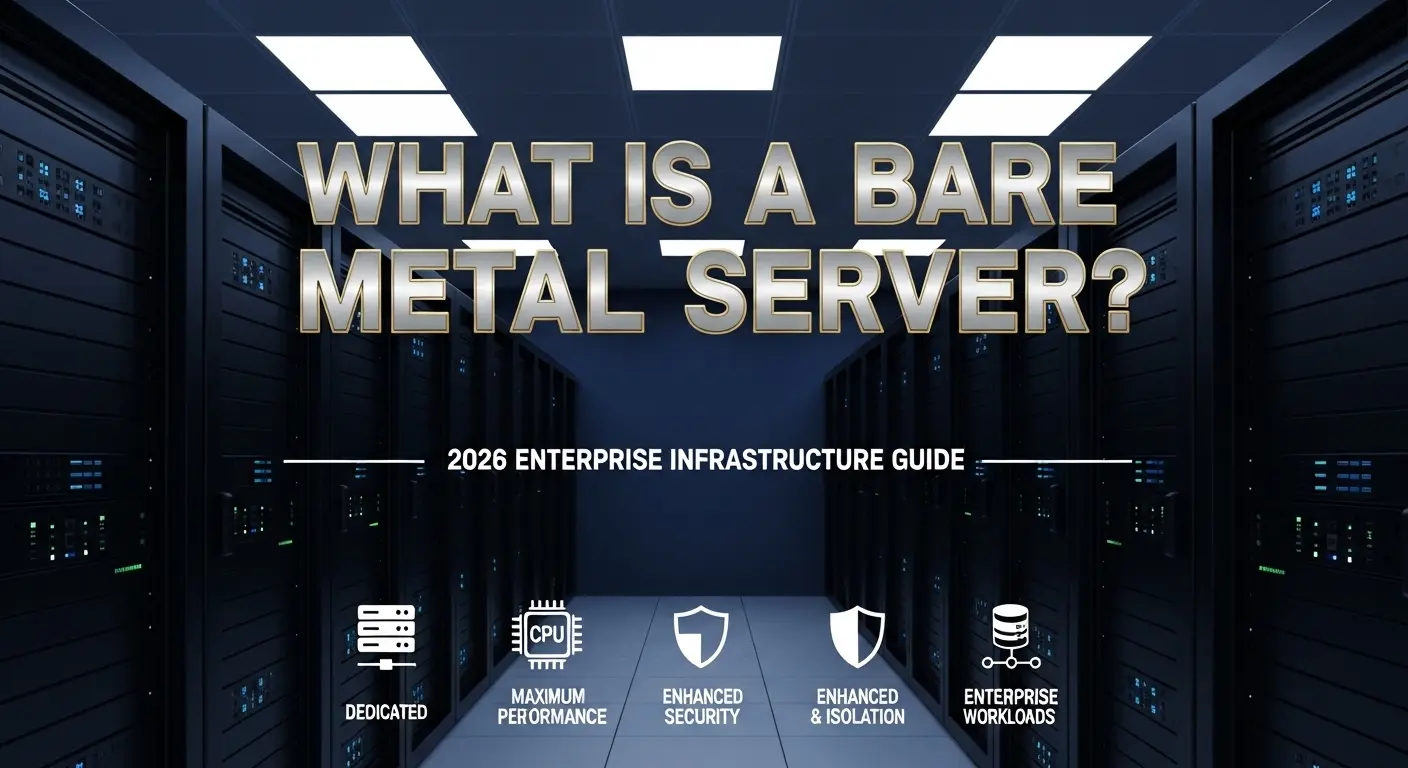
What is a Bare Metal Server? The 2026 Enterprise Infrastructure Guide
A kale metalen server is a physical machine dedicated to a single tenant, running its operating system directly on the hardware without a virtualization layer. Unlike virtual machines (VMs) that share resources via a hypervisor, bare metal provides exclusive, unmediated access to the CPU, RAM, storage, and network interface cards.
Op Atal Networks, we specialize in Kale metalen servers that bridge the gap between raw physical power and cloud-like automation.
Technical Architecture: Why Hardware Matters
The core “bare metal meaning” refers to the hardware being devoid of any pre-installed hypervisor software. This architecture eliminates virtualization overhead, which typically consumes 5–15% of a server’s processing power just to manage the VM environment.
Key Components of Modern Bare Metal
- Single Tenancy: Every CPU cycle and memory allocation belongs exclusively to your organization, eliminating the “noisy neighbor” effect common in shared cloud environments.
- Direct I/O Access: Applications communicate directly with PCIe devices, such as NVIDIA H100 GPUs or NVMe drives, which is critical for latency-sensitive workloads like high-frequency trading.
- API-Driven Provisioning: Modern platforms like Atal Networks allow you to treat physical infrastructure as code (IaC), spinning up dedicated clusters in minutes rather than days.
The Definitive Guide to Bare Metal Infrastructure: Core Technical Features
In a modern enterprise environment, the bare metal server is the foundation of high-performance computing. By delivering a physical machine dedicated to a single tenant where the operating system runs directly on the hardware, organizations gain unmediated access to raw computing power.
Below are the five defining pillars of bare metal infrastructure, engineered for the highest standards of performance and reliability.
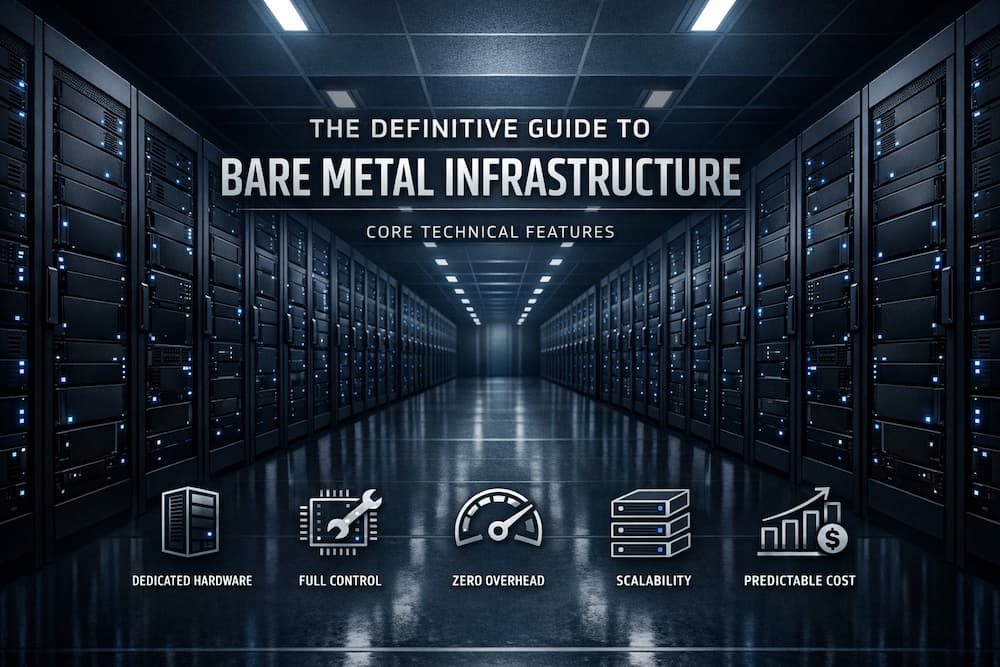
1. Tenancy: Physical Isolation and Resource Sovereignty
Tenancy in a bare metal environment is strictly single-tenant, meaning a physical computer is reserved exclusively for one user. This architecture provides complete control over hardware resources and eliminates the “noisy neighbor” effect, ensuring that your workload never competes with others for CPU cycles or memory bandwidth.
- Hardware Control: Users maintain full authority over hardware configurations, firmware, and BIOS settings.
- Physical Security: Isolation at the hardware level reduces cross-tenant attack vectors and vulnerabilities associated with shared layers.
- Compliance: The dedicated nature of the hardware supports strict regulatory requirements for finance, healthcare, and government sectors.
2. Provisioning: From Manual Deployment to Cloud Agility
The provisioning of bare metal servers has evolved from manual, technician-led setups to sophisticated, API-driven automation. Modern Bare Metal as a Service (BMaaS) allows for rapid deployment through automated workflows.
- Automation: Infrastructure can be deployed via API or CLI, enabling “Infrastructure as Code” (IaC) strategies for physical hardware.
- Provisioning Speed: While traditional dedicated servers involve manual setup, modern bare metal cloud models offer significantly faster deployment times to meet dynamic business needs.
- Full Stack Control: Users can choose their own operating systems, custom kernels, or even install their own hypervisors to create private cloud environments.
3. Performance: Zero-Overhead Throughput
The primary driver for bare metal adoption is maximum performance. Because the operating system interacts directly with the physical hardware components, the “virtualization tax” is eliminated.
- High Throughput: Bare metal provides consistent, high-throughput performance for compute-intensive tasks like High-Performance Computing (HPC) and big-data analytics.
- Lage latentie: Direct hardware access enables the ultra-low latency required for real-time video streaming, multiplayer gaming, and high-frequency financial transactions.
- AI/ML Optimization: Specialized hardware, such as GPU-accelerated bare metal, is ideal for training deep learning models where raw processing power is critical.
4. Scaling: Strategic Expansion and Horizontal Elasticity
Scaling a bare metal environment involves physical hardware expansion, which ensures that every new node provides a predictable, dedicated resource pool.
- Horizontal Scaling: Modern bare metal cloud platforms facilitate horizontal scaling by allowing users to provision additional dedicated nodes via automated interfaces.
- Predictable Growth: Because resources are not shared or over-provisioned, scaling remains performance-predictable even under heavy enterprise-scale loads.
- Hybrid Integration: Bare metal is frequently integrated with container orchestration platforms like Kubernetes to provide a scalable foundation for microservices.
5. Cost Model: Long-Term Predictability and TCO Optimization
The cost model for bare metal typically reflects the specialized, high-performance nature of the hardware, transitioning from traditional fixed costs to flexible cloud models.
- Predictable Expenditure: Bare metal is highly cost-effective for steady, long-term workloads where resource utilization is consistent, offering a clear Total Cost of Ownership (TCO).
- Consumption Models: Modern bare metal cloud providers have introduced “pay-as-you-go” or hourly billing models, providing the flexibility to handle seasonal or dynamic traffic bursts.
- Value of Performance: For resource-intensive applications, the performance gains of bare metal often translate to fewer required nodes compared to less efficient options, potentially lowering overall infrastructure costs.
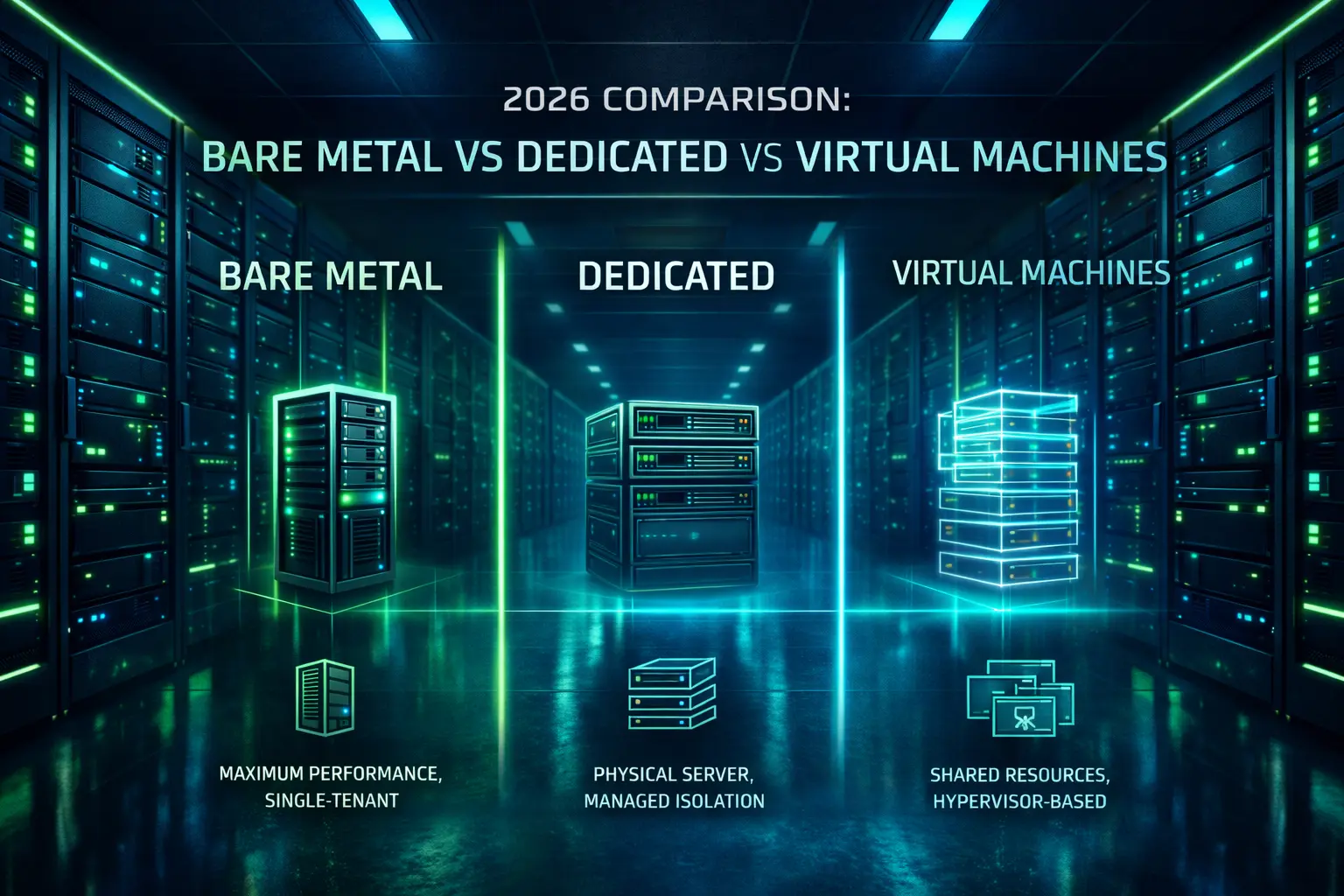
2026 Comparison: Bare Metal vs. Dedicated vs. Virtual Machines
While “bare metal” and “Toegewijde servers” both provide physical isolation, the industry distinction is now defined by deployment speed and billing flexibility.
| Kenmerken | Bare Metal Cloud | Traditional Dedicated | Virtual Machines (VMs) |
| Tenancy | Single-tenant (Isolated) | Single-tenant (Isolated) | Multi-tenant (Shared) |
| Provisioning | < 120 Seconds (Automated) | Days to Weeks (Manual) | Seconds (Instant) |
| Prestatie | Native (No Overhead) | Native (No Overhead) | ~85-95% efficiency |
| Scaling | Horizontal via API/CLI | Manual hardware upgrades | Vertical (Instant resizing) |
| Cost Model | Hourly / Pay-as-you-go | Monthly / Yearly contracts | Usage-based |
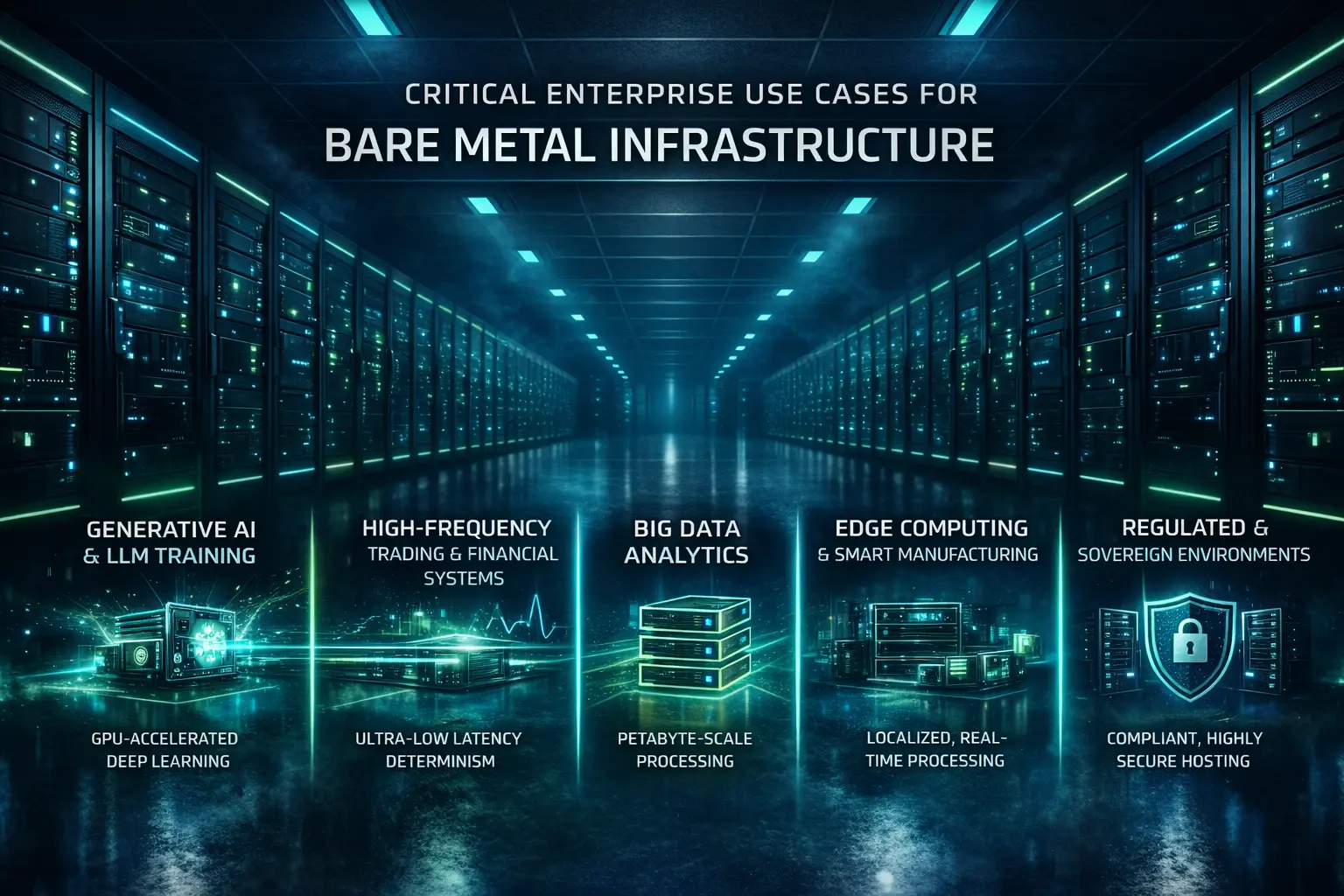
Critical Enterprise Use Cases for Bare Metal Infrastructure
In the current infrastructure landscape, the shift toward bare metal is driven by the need for deterministic performance that virtualized environments cannot guarantee. Below are five critical use cases where the raw power and isolation of bare metal are essential for enterprise success.
1. Generative AI Training and Large Language Models (LLMs)
Training billion-parameter AI models requires sustained, high-density compute power that can consume thousands of GPUs simultaneously.
- Technical Advantage: Bare metal provides unfiltered access to GPU memory and high-speed interconnects (such as NVLink), ensuring that AI accelerators like the NVIDIA H100 or H200 are never “starved” of data by hypervisor bottlenecks.
- Business Impact: By eliminating the “virtualization tax,” organizations achieve faster model convergence and reduced training times, directly accelerating time-to-market for AI-driven products.
2. High-Frequency Trading (HFT) and Financial Services
In global capital markets, where transaction speeds are measured in microseconds, the predictability of hardware is a competitive necessity.
- Technical Advantage: Bare metal infrastructure minimizes context-switching delays and “jitter,” providing the ultra-low latency required for market-making algorithms and real-time risk modeling.
- Business Impact: Financial firms utilize dedicated resources to execute thousands of trades per second, reducing slippage and ensuring that risk exposures—such as Value at Risk (VaR) calculations—are updated in real-time.
3. Big Data Analytics and High-Volume Data Collection
Enterprises managing petabyte-scale datasets for business intelligence require high-throughput storage and massive parallel processing.
- Technical Advantage: Bare metal enables direct NVMe access and 100GbE internal networking, which is critical for ingestion pipelines and in-memory databases like SQL or MongoDB.
- Business Impact: It provides consistent, repeatable performance for large-scale data warehousing, preventing data loss during usage spikes that often occur in shared multi-tenant environments.
4. Edge Computing and Smart Manufacturing
The rise of Industrial IoT (IIoT) requires processing data at the source to enable immediate, autonomous decision-making.
- Technical Advantage: Deploying bare metal at the edge—such as in smart factories or near autonomous vehicle clusters—removes the latency of a round-trip to a centralized cloud.
- Business Impact: Real-time video analytics and predictive maintenance systems can trigger hardware shutdowns in milliseconds to prevent equipment failure or safety incidents on a manufacturing floor.
5. Regulated Industries and Sovereign AI Compliance
Healthcare, defense, and government sectors face rigorous data residency and security mandates that shared infrastructure often fails to meet.
- Technical Advantage: Physical hardware isolation ensures that sensitive data—such as electronic Protected Health Information (ePHI) or proprietary research—never leaves a controlled, single-tenant environment.
- Business Impact: Organizations simplify regulatory audits (HIPAA, GDPR, PCI-DSS) by demonstrating clear infrastructure boundaries and maintaining total jurisdictional control over their data.
2026 Best Practices for Bare Metal Management
Optimizing enterprise grade bare metal requires a shift from manual administration to automated lifecycle management.
- Implement Infrastructure as Code (IaC): Use tools like Terraform or Ansible to automate server provisioning and configuration across global data centers.
- Proactive Health Monitoring: Deploy Prometheus or Zabbix to track memory utilization and hardware thermals, setting alerts to prevent hardware failure.
- Zero Trust Security: Disable unnecessary ports, implement Multi-Factor Authentication (MFA), and perform regular firmware/OS patch audits to minimize the attack surface.
- Backup & Disaster Recovery: Schedule daily off-site backups of critical configurations, ensuring a recovery time objective (RTO) of under 4 hours.
Why Atal Networks for Bare Metal?
Atal Networks delivers enterprise-grade infrastructure across 196+ landen en 213+ locations. Our network is engineered for 2026’s most demanding applications.
- 10Gbps Dedicated Uplinks: Unshared network ports ensure your applications never experience congestion.
- Tier III & IV Data Centers: 99.99% uptime guarantee with redundant power and cooling systems.
- Unmetered Bandwidth: Plans including 100TB or fully unmetered data transfer to eliminate overage surprises.
- Global IPv4 Leasing: Advanced IP management options for SaaS and VPN providers.
Conclusion: Making the Right Choice
Choose bare metal if your revenue or safety depends on predictable latency and consistent power. For businesses scaling rapidly in 2026, the performance gains of physical hardware often result in a lower Total Cost of Ownership (TCO) compared to complex, over-provisioned cloud environments.