 Ga naar de inhoud








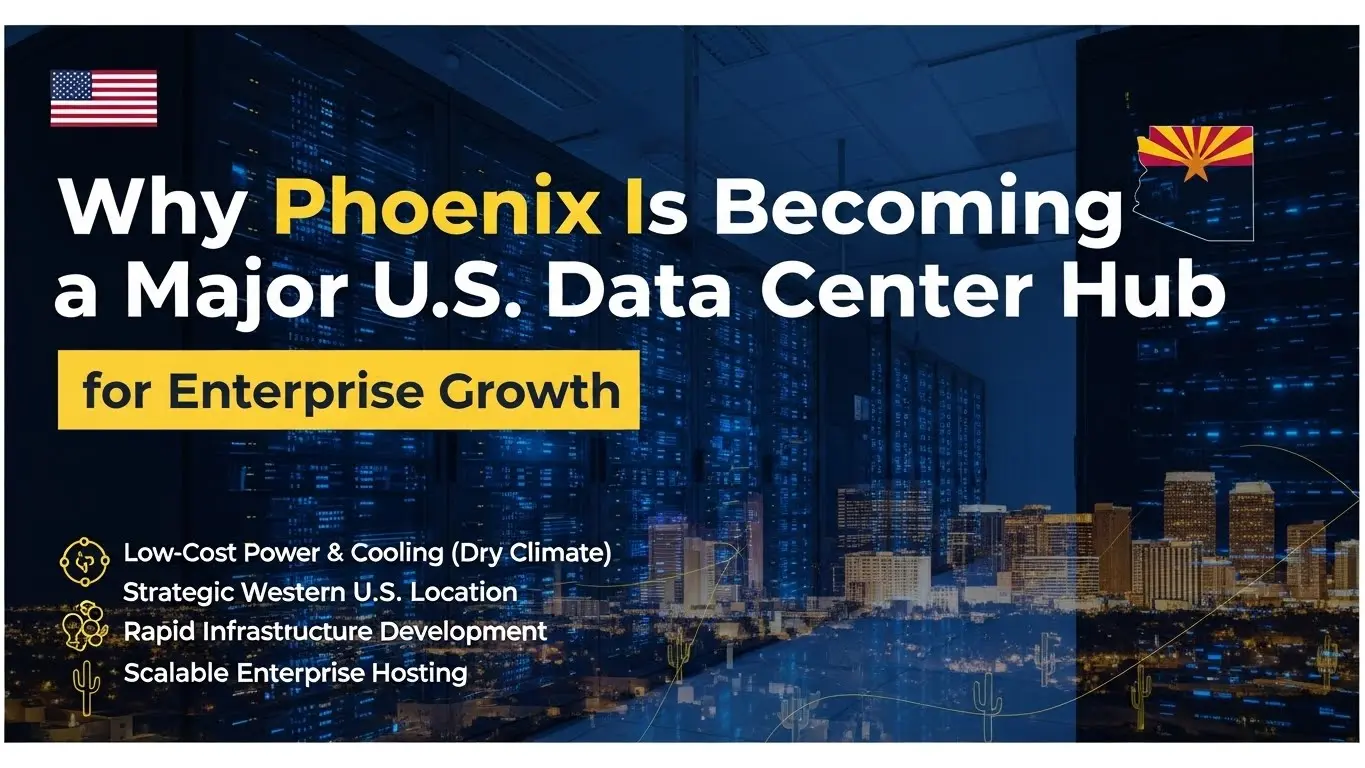
The Silicon Desert: The Definitive Analysis of Phoenix as a Global Data Center Hub
Phoenix is emerging as a top U.S. data center hub due to AI demand, low disaster risk, strong fiber networks, tax incentives, and scalable power infrastructure.
Key Takeaways: The Phoenix Data Center Advantage
- AI-Driven Growth: Phoenix is the second-largest U.S. market for planned data center development, driven largely by the explosion of Artificial Intelligence (AI) and hyperscale computing requirements.
- Physical Safety: The region offers a 99.9% low-risk profile regarding natural disasters (no hurricanes, earthquakes, or floods), making it a premier disaster recovery hub.
- Economic Incentives: Aggressive state tax abatements (qualifying investments as low as $25M) and transaction-privilege-tax exemptions significantly lower Total Cost of Ownership (TCO).
- Infrastructure at Capacity: With 90% of new industrial electricity consumption attributed to data centers, utilities like APS and SRP are managing grid strain, leading to a pivot toward renewable energy and sustainable cooling innovations.
- Strategic Connectivity: Located on major fiber-optic pipelines, Phoenix provides low-latency connectivity to California, Texas, and Latin American markets.
Introduction: The Rise of the Silicon Desert
Phoenix, Arizona, has transformed from a regional logistics hub into a global powerhouse for digital infrastructure. Recent industry analysis positions the Phoenix metropolitan area as the second-largest U.S. data-center growth market, with a projected capacity increase of over 553% in the near term.
This rapid ascent—often referred to as the rise of the “Silicon Desert”—is not accidental. It is the convergence of geographical stability, aggressive economic policy, and the sudden, insatiable demand for compute power driven by Generative AI. From the proposed $25 billion Hassayampa Ranch project to the expansion of chip manufacturers like TSMC and Intel, the ecosystem is attracting billions in capital. However, this growth brings complex challenges regarding power grids, water sustainability, and community impact that stakeholders must navigate.
This report provides a comprehensive, data-backed analysis of the Phoenix market, designed to help enterprise leaders, investors, and infrastructure planners understand the opportunities and risks of deploying in the region.
1. The Catalyst: How AI is Reshaping the Market

While data centers have existed in Phoenix for decades, the current market dynamics are distinct due to the AI boom. Unlike traditional cloud storage, AI training and inference require “hyperscale” facilities with massive power densities.
- Mega-Project Emergence: We are witnessing the shift from multi-megawatt campuses to gigawatt-scale developments. The proposed Hassayampa Ranch near Phoenix aims for a 1.5-GW capacity, illustrating the scale of investment flowing into the region.
- Demand Projections: Current IT capacity in the metro area is estimated at 707 MW, but demand could skyrocket to 19,000 MW if all proposed projects connect to the grid.
- Supply Chain Synergy: The presence of semiconductor manufacturing (e.g., TSMC’s $165 billion commitment) creates a localized supply chain advantage for hardware-intensive AI operations.
2. Core Advantages: Why Enterprise Chooses Phoenix
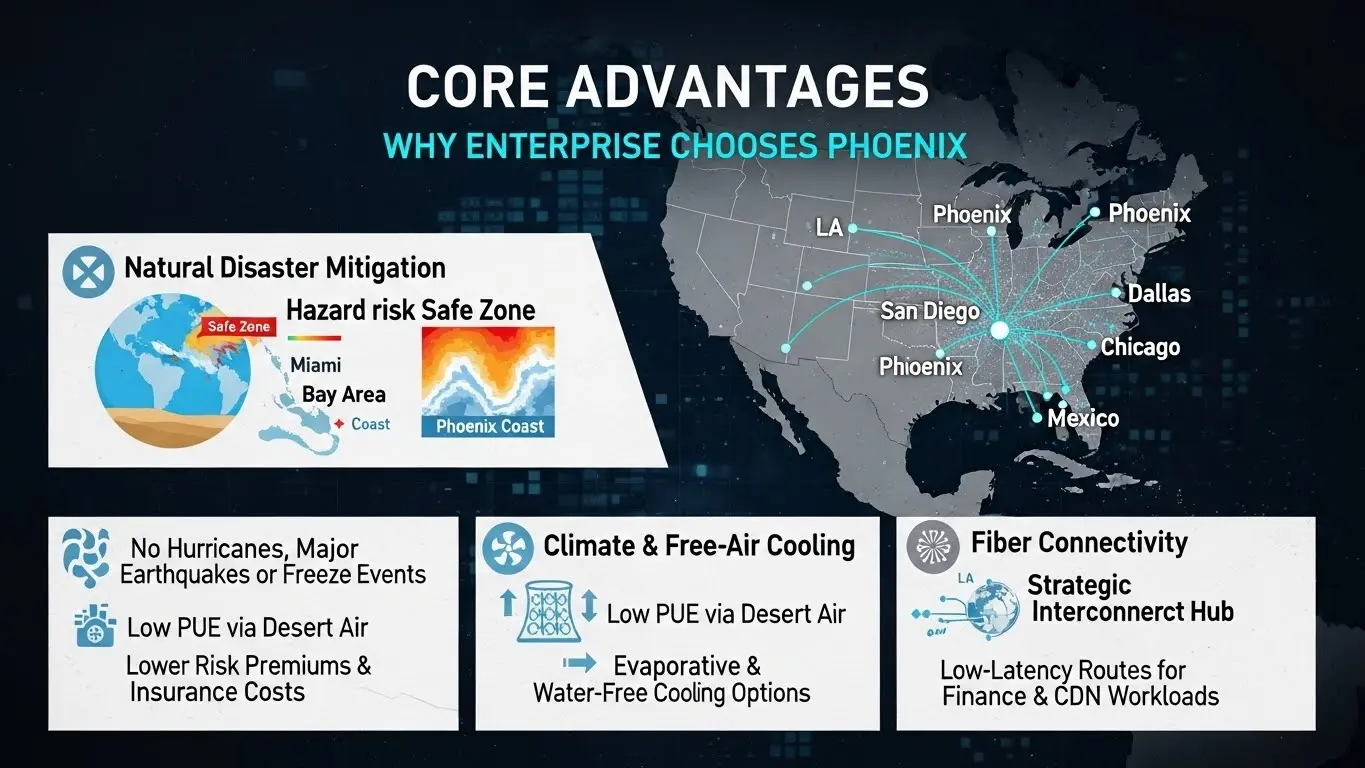
Competitor analysis indicates that successful deployment in Phoenix relies on three primary pillars: Physical Safety, Climate Efficiency, and Connectivity.
A. Natural Disaster Mitigation
For enterprises prioritizing business continuity, Phoenix offers a distinct geographic advantage. The region is largely free from:
- Hurricanes/typhoons
- Major earthquakes
- Severe winter freeze events
This predictability allows data center operators to design facilities with lower risk premiums and insurance costs compared to coastal hubs like Miami or the Bay Area.
B. Climate & Free-Air Cooling
Phoenix’s arid climate allows for efficient cooling strategies that reduce Power Usage Effectiveness (PUE).
- Free-Air Cooling: For much of the year, the dry desert air allows cooling towers to reject heat without mechanical refrigeration.
- Adiabatic Systems: Even during summer months, evaporative cooling is highly efficient due to low humidity, though operators are increasingly adopting water-free cooling technologies to address sustainability concerns.
C. Fiber Connectivity
Phoenix sits on a critical fiber-optic crossroads, connecting the West Coast (Los Angeles, San Diego) to the interior U.S. (Dallas, Chicago) and southward into Mexico. This strategic location provides low-latency routes essential for financial services and content delivery networks (CDNs).
3. Economic Drivers and Incentive Structures
Arizona has cultivated a pro-business regulatory environment that actively competes for tech investment.
| Incentive Type | opdracht | Impact on TCO |
| Tax Abatements | Qualifying data centers (investments as low as $25M) are exempt from state and local transaction privilege taxes on equipment and electricity. | Significant reduction in operational OpEx over the lifecycle of the facility. |
| Streamlined Permitting | Municipalities like Goodyear and Mesa offer predictable, expedited permitting processes for zoned industrial land. | Reduces “speed-to-market” by months, critical for AI deployment timelines. |
| Talent Pipeline | Proximity to Arizona State University (ASU) provides a steady stream of engineering graduates. | Ensures availability of skilled labor for facility management and network operations. |
Data Source: AAED, BMS Commercial Services, Novva Data Centers
4. The Sustainability Paradox: Power and Water

The rapid expansion of the “Silicon Desert” is creating friction points with local resources. Enterprise-grade planning must account for these constraints.
The Energy Challenge
The sheer volume of new construction is straining the grid.
- Grid Stress: APS and SRP (local utilities) report that 90% of new industrial load is from data centers. In some instances, utilities have had to turn away new customers until infrastructure upgrades are completed.
- The Solution: The market is pivoting toward Renewable Energy Credits (RECs) and on-site solar. Arizona’s abundant sunshine makes it an ideal location for solar-powered campuses, helping companies meet carbon-neutral goals.
Water Usage vs. Energy Savings
There is an inherent trade-off in desert cooling: using water saves electricity, but water is a scarce resource.
- Community Concerns: Local communities and news outlets (KJZZ, AZ Family) have raised valid concerns about the impact of groundwater pumping on residential water supplies.
- Industry Response: Leaders like Meta en Microsoft are implementing “net-positive water” strategies, replenishing water tables through restoration projects. Newer facilities are prioritizing air-cooled chillers to eliminate water usage entirely.
5. Infrastructure Providers and Ecosystem
Phoenix hosts a mix of hyperscale cloud providers, retail colocation operators, and niche managed service providers. When selecting a partner in Phoenix, enterprises should evaluate density capabilities and network diversity.
- Hyperscale: Meta, Microsoft, Google.
- Wholesale Colocation: NTT Data, Stack Infrastructure, Iron Mountain, EdgeConneX.
- Bare Metal & Managed Services: For enterprises requiring specific configurations or compliance needs, partners offering Toegewijde servers in Phoenix provide the necessary hardware control without the CapEx of building a private facility.
Navigating Hosting Options in Phoenix
Depending on your compliance and latency requirements, the ecosystem offers diverse deployment models:
- High-Performance Compute: Organizations needing raw power often opt for Phoenix USA VPS Servers to balance scalability with cost-efficiency.
- Strategic Connectivity: For businesses operating across the continent, Phoenix serves as a critical node. Leveraging a provider with robust Noord amerika network footprints ensures low-latency data transmission to key markets.
- Privacy & Sovereignty: As data regulations evolve, some enterprises look for hosting solutions that offer specific legal protections or flexible DMCA policies. Providers specializing in Offshore DMCA negeerde hosting can offer distinct advantages for content publishers facing jurisdictional challenges, though these are often housed in specific legal jurisdictions outside the mainland US.
Looking for a comprehensive partner? Visit Atal Networks to explore deployment options in the Phoenix ecosystem.
6. Future Outlook
The trajectory for Phoenix indicates sustained growth, but the market is maturing.
- Rankings: As of late 2024, Phoenix ranks fourth in total data-center inventory in North America, rapidly closing the gap on Dallas and Northern Virginia.
- Innovation: We expect to see increased adoption of liquid cooling for AI chips and advanced battery storage systems to stabilize the grid during peak usage.
- Regulation: Zoning laws will likely become stricter regarding noise and water usage. Early adopters who prioritize sustainability will have a competitive advantage in securing permits.
Veelgestelde vragen (FAQ)
Why are tech giants moving to Phoenix?
Tech giants are moving for the combination of low risk of natural disasters, affordable power, robust fiber connectivity, and aggressive state tax incentives that lower operational costs.
Is Phoenix running out of power for data centers?
Not necessarily running out, but the grid is strained. Utilities like APS are currently struggling to connect the 19,000 MW of proposed demand. This is driving a massive investment in grid infrastructure and renewable energy generation.
Does the lack of water in Arizona affect data centers?
Yes, water usage for cooling is a major concern. However, the industry is innovating rapidly. Many new facilities use “air-cooled” chillers that use minimal to no water, while others are purchasing water credits to replenish local supplies.
How does Phoenix compare to Silicon Valley for data centers?
Phoenix offers significantly lower real estate costs, cheaper electricity, and a safer climate profile (no earthquakes). While Silicon Valley remains a hub for innovation, Phoenix has become the hub for infrastructure serving the West Coast.
References
- Arizona Association for Economic Development (AAED) – Arizona’s Data Center Boom: Balancing Growth & Impact
- Velocity Retail Group – Why Arizona’s Data Center Boom Is About To Explode With AI Adoption
- AZ Big Media – Phoenix ranks No. 2 in US for planned data center development
- KJZZ (Díaz and Boas) – Arizona is a data center hub. That brings huge companies, but also drains water
- AZ Family – Data centers pushing Phoenix area’s power grid to the limit
- Upwind – U.S. Data Center Powerhouses: The 5 Fastest-Growing Hubs
- Fortune – At the edges of the AI data center boom, rural America is up against Silicon Valley billions
- APM Research Lab – Are data centers depleting the Southwest’s resources?
- Data Center Frontier – Why Phoenix is an Increasingly Hot Data Center Market
- Novva Data Centers – Why Are So Many Data Centers Moving to Arizona?