 콘텐츠로 건너뛰기








AI vs. Machine Learning vs. Deep Learning: What’s the Difference?
Artificial Intelligence (AI) is the defining technology of our era, yet the terminology surrounding it is constantly misused. You will often hear business leaders and media outlets use “AI,” “machine learning” (ML), and “deep learning” (DL) as if they mean the exact same thing. They do not.
To understand modern technology—and where tools like ChatGPT actually fit—you need to know the difference.
Here is the complete, beginner-friendly guide to understanding AI, machine learning, and deep learning, how they relate to one another, and exactly when you should use each term.
Executive Answer: The 30-Second Summary
If you are looking for the exact definitions to use in your next meeting, here they are:
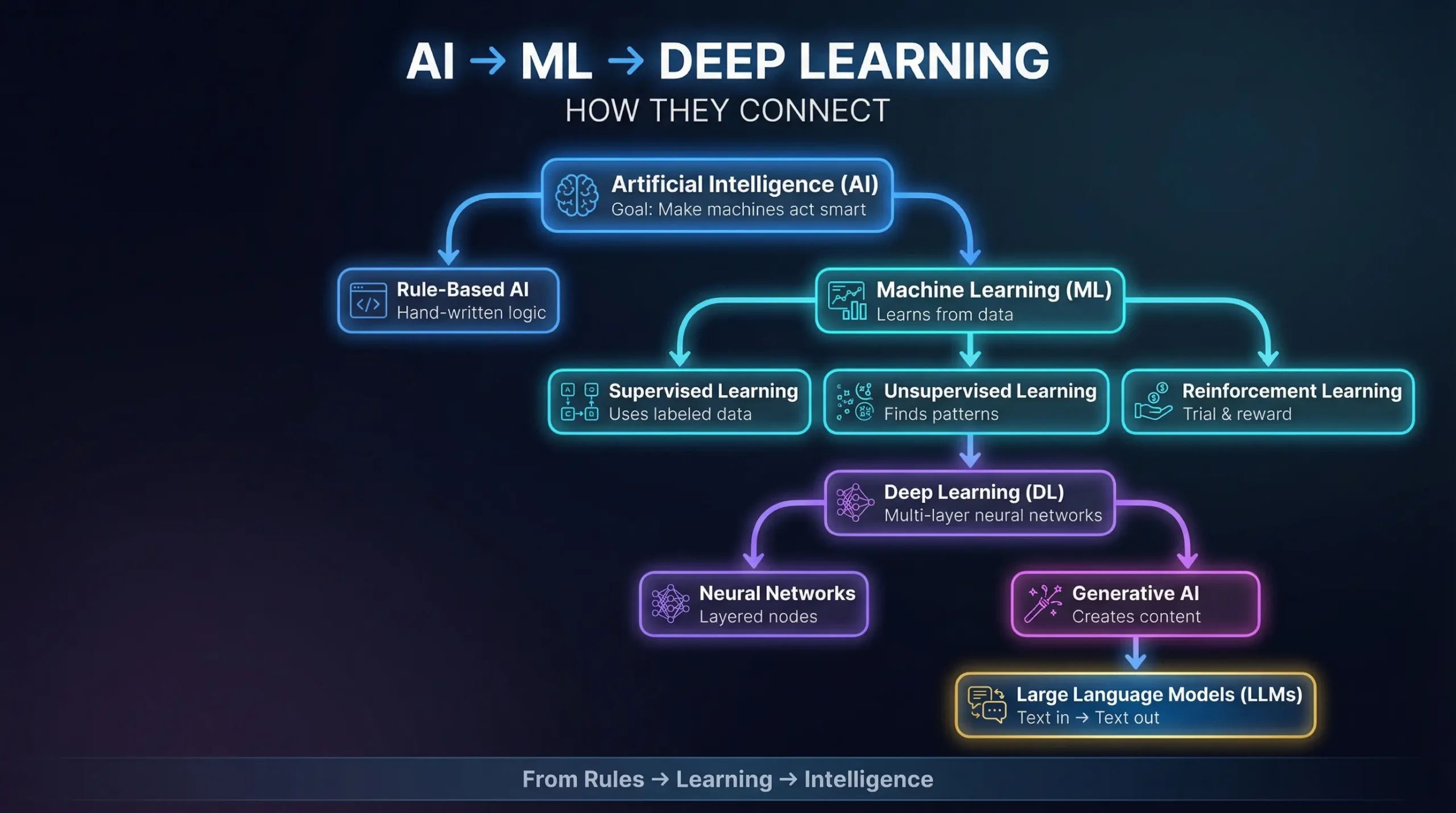
- Artificial Intelligence (AI): The broad concept of making computers act “smart” and mimic human problem-solving capabilities.
- Machine Learning (ML): A specific way to do AI where the computer learns from data to improve its performance, instead of relying on hand-written rules.
- Deep Learning (DL): A highly advanced type of machine learning that uses multiple layers of artificial “neural networks,” becoming exceptionally powerful when fed massive amounts of data.
The Simplest Way to Picture the Relationship
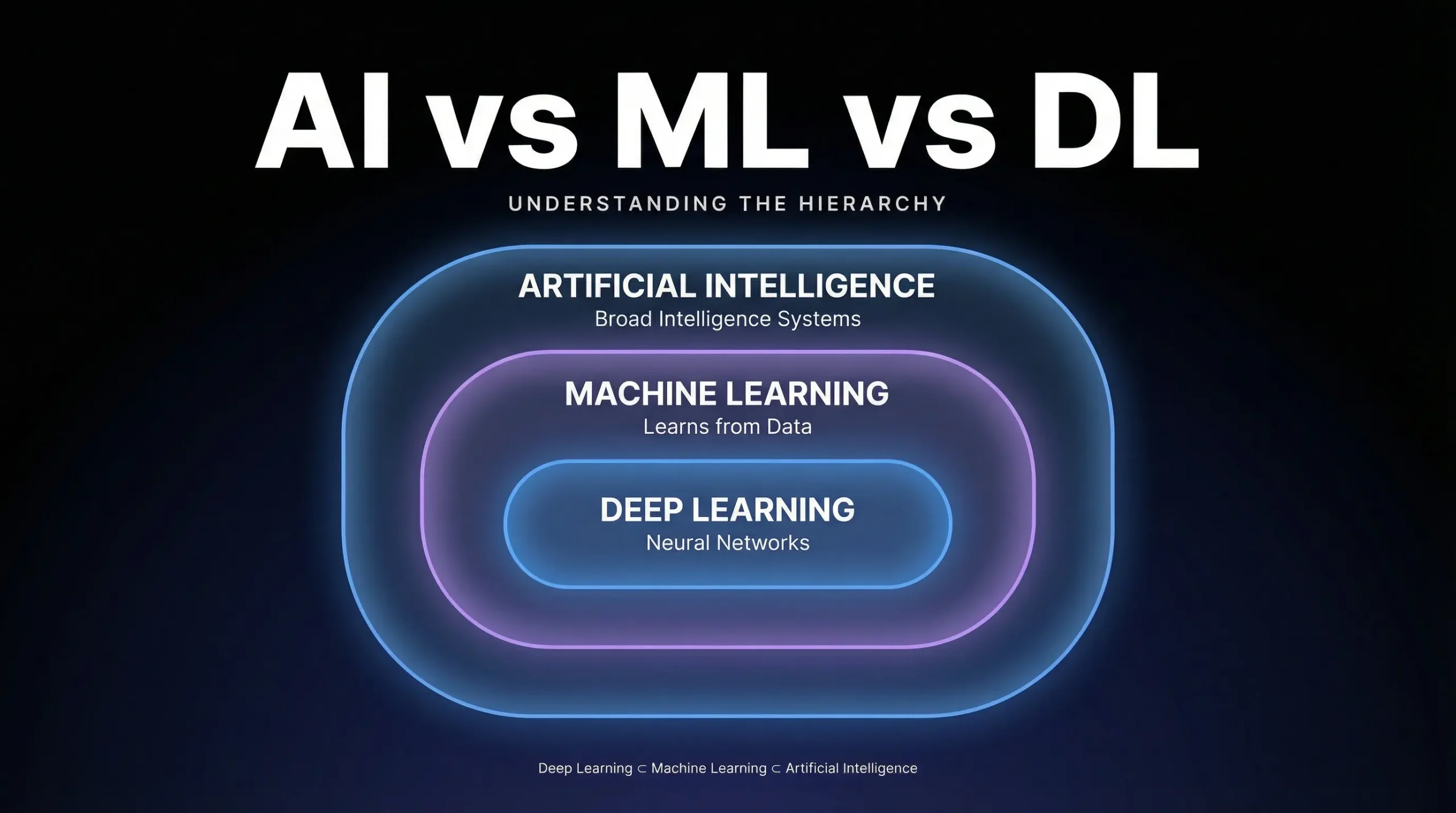
The most accurate way to understand how these technologies fit together is to picture them as a set of nested circles.
- AI is the outer umbrella: It contains everything.
- ML is the middle circle: It is a subset sitting completely inside the AI circle.
- DL is the center circle: It is a smaller subset sitting completely inside the machine learning circle.

What AI Means (And Why People Confuse It)
The concept of “Artificial Intelligence” is not new. The term was officially coined during a 1955 Dartmouth College research proposal, which sought to find how to make machines use language, form abstractions, and solve problems reserved for humans. Just prior to that, in 1950, computing pioneer Alan Turing proposed the “imitation game”—now famous as the Turing Test—to measure a machine’s ability to exhibit intelligent behavior.
The reason people get confused today is that they forget a core fact: Not all AI learns.
Rule-Based AI vs. Learning-Based AI
To understand AI, you must split it into two historical camps:
- Rule-Based AI (Good Old-Fashioned AI): In the early days, programmers wrote thousands of strict “If X happens, do Y” rules. Consider a tax calculator or the famous chess computer Deep Blue that beat Garry Kasparov in 1997. Deep Blue was brilliant, but it didn’t learn chess; it evaluated millions of programmed possibilities based on human-written rules.
- Learning-Based AI: This is the modern era. Instead of hard-coding every rule, engineers feed the computer data and let it figure out the rules itself. This brings us to machine learning.
What Machine Learning Means (How “Learning” Works)
Machine learning (ML) shifted the paradigm of computer science. Instead of programming a computer to solve a task, we program a computer to learn to solve a task.
Two legendary computer scientists gave us the academic definitions we still use today:
- Arthur Samuel (1959): Described ML as the field of study that gives computers the ability to learn without being explicitly programmed.
- Tom Mitchell (1997): Provided the engineering definition, stating that a computer program learns from “experience” with respect to some “task” if its performance improves with that experience.
The Simple ML Workflow
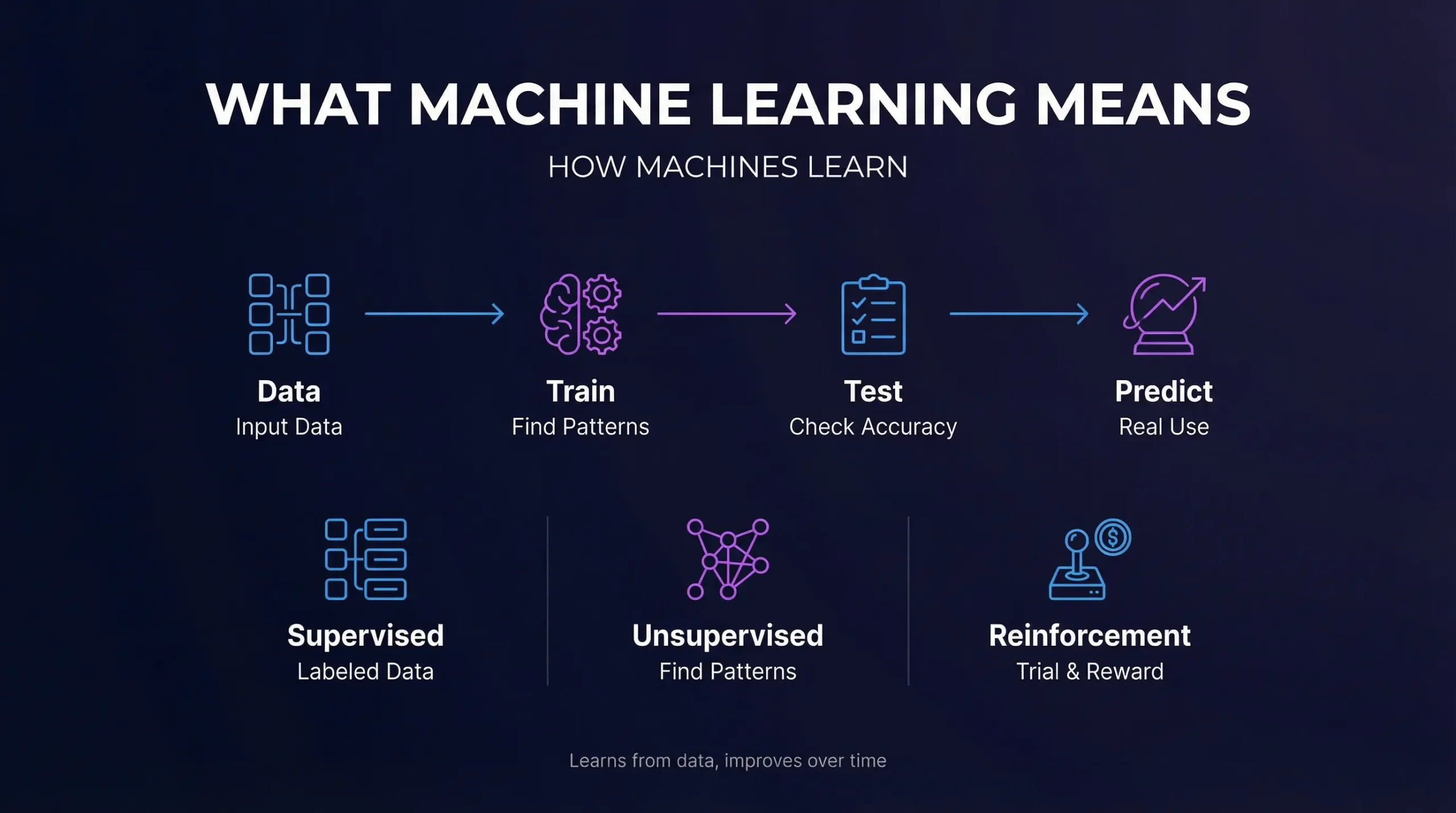
How does a machine actually learn? It generally follows a four-step cycle:
- Data Ingestion: You provide historical data (e.g., 100,000 emails, some marked “spam” and some marked “safe”).
- Training Phase: The algorithm analyzes the data, searching for mathematical patterns (e.g., emails with the word “Lottery winner” and a link are usually spam).
- Testing Phase: You give the model new, unseen emails to see if its predictions are accurate.
- Inference (Use): The trained model is deployed to automatically filter your inbox in real-time.
The Three Main Types of Machine Learning
- Supervised Learning: The algorithm is trained on clearly labeled data. Example: A system trained on photos explicitly labeled “cat” or “dog” so it can classify future photos.
- Unsupervised Learning: The algorithm is given messy, unlabeled data and asked to find hidden structures or groupings. Example: An e-commerce site clustering customers with similar buying habits without knowing exactly what to call those clusters.
- Reinforcement Learning: The algorithm learns purely by trial and error in a simulated environment, earning a mathematical “reward” for good decisions. Example: An AI learning to walk in a physics simulator.
What Deep Learning Means (What Makes It “Deep”)
Deep learning (DL) is the cutting-edge technology responsible for the massive AI boom we are living through right now.
It is built on artificial neural networks, a computing architecture loosely inspired by the biological neurons in the human brain. While early neural networks existed for decades, foundational research by computer scientists like Yann LeCun, Yoshua Bengio, and Geoffrey Hinton proved that stacking these networks into complex layers yielded extraordinary results.
The Layers of Deep Learning
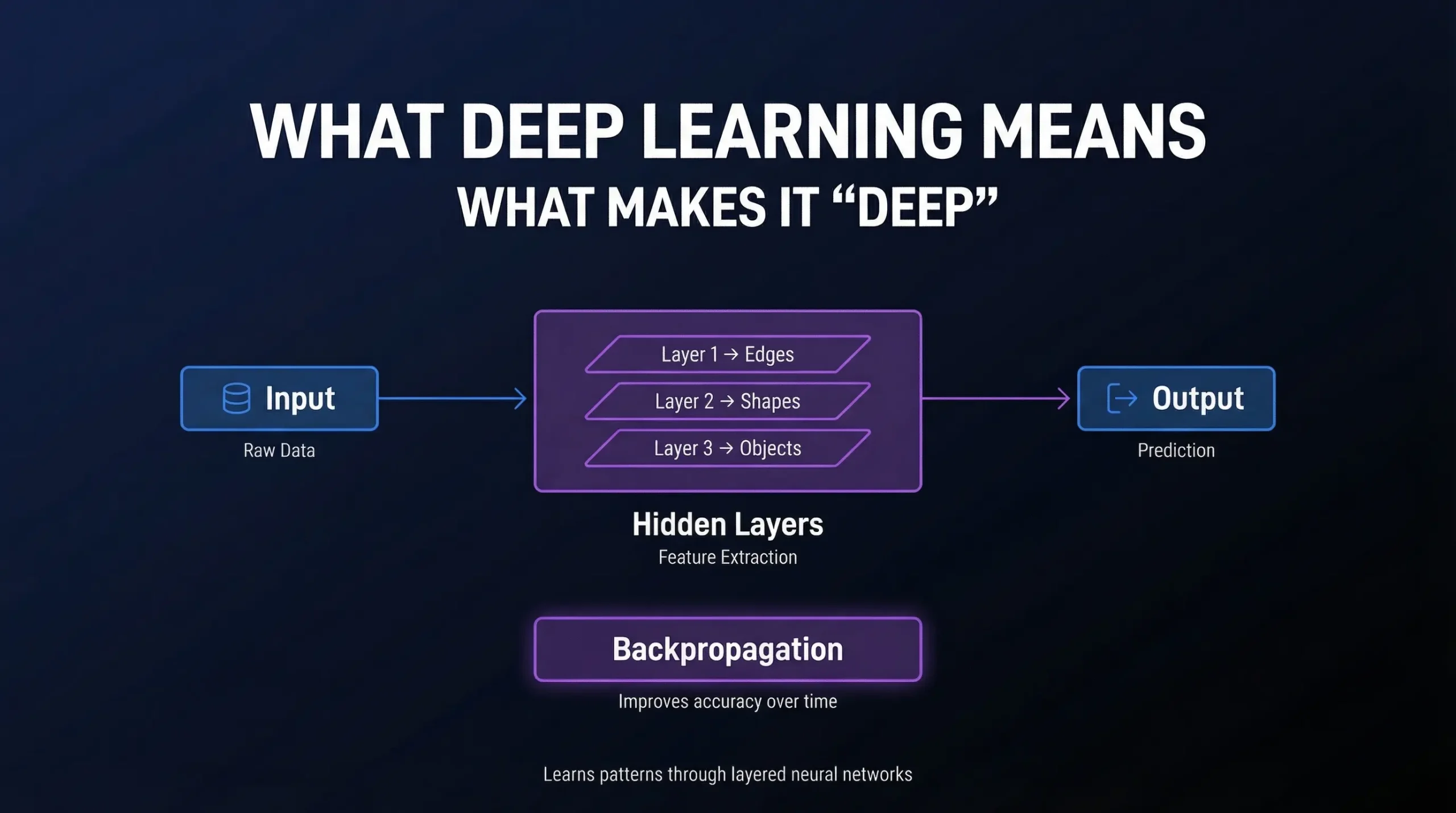
What makes deep learning “deep”? It refers to the number of processing layers the data must pass through:
- Input Layer: The raw data (pixels of an image, audio waves of a voice) enters the system.
- Hidden Layers: This is the “deep” section. Data passes through multiple dense layers of artificial neurons. Each layer extracts more complex features. For a facial recognition system, Layer 1 might just look for edges and shadows, Layer 2 looks for shapes (eyes, noses), and Layer 3 identifies a specific face.
- Output Layer: The system delivers its final prediction or generated content.
To correct its mistakes, deep learning relies on a complex mathematical procedure called backpropagation, which adjusts the internal “weights” (importance) of the connections after every guess so the model gets smarter over time.
Where Do Generative AI and LLMs Fit?
Generative AI tools (like ChatGPT, Claude, or Midjourney) are the newest evolution of this technology.
- Generative AI is usually built upon deep learning models.
- Large Language Models (LLMs) are a specific type of deep learning model trained on terabytes of human text. Because they process language through incredibly deep neural layers, they can predict the most logical “next word” in a sequence, allowing them to write human-sounding essays, code, and conversational responses.
The “Use the Right Word” Decision Guide
Stop mixing the terminology. Use this simple framework to know exactly which word to use in professional settings.
| 얼굴의 생김새 | Artificial Intelligence (AI) | Machine Learning (ML) | Deep Learning (DL) |
| Simple Definition | Any system that mimics human intelligence. | A system that learns from data to improve its task. | A multi-layered neural network system for complex data. |
| How it Works | Can use hard-coded rules 또는 learn from data. | Uses statistical algorithms to find patterns. | Uses massive arrays of artificial neurons and backpropagation. |
| Data Requirement | Varies (Rule-based AI needs no historical data). | Requires a moderate amount of structured data. | Requires colossal amounts of raw, unstructured data. |
| Computing Power | Low to Moderate. | Moderate. | Exceptionally High (Requires powerful GPU chips). |
| Best Used For | General problem solving, simple automation. | Price prediction, recommendation engines, spam filters. | Image recognition, voice translation, Large Language Models. |
The Golden Rules of AI Terminology
- Rule 1: If the system is smart, but relies entirely on human-written rules, say AI.
- Rule 2: If the system actively looks at historical data to improve its predictions without you reprogramming it, say Machine Learning.
- Rule 3: If the system is using neural networks to process massive, complex datasets like human speech, high-res images, or creative writing, say Deep Learning.
자주 묻는 질문(FAQ)
What is AI in simple words?
Artificial Intelligence (AI) is the broad science of creating computer systems capable of performing tasks that typically require human intelligence. This includes understanding language, recognizing patterns, solving problems, and making decisions.
Is machine learning the same as AI?
No, they are not exactly the same. Machine learning is a specialized sub-field within Artificial Intelligence. While all machine learning is a form of AI, not all AI uses machine learning.
Do all AI systems use machine learning?
No. Many early and highly reliable AI systems are “rule-based.” This means they rely on strict, human-written “if-then” codes rather than learning independently from data.
Is deep learning part of machine learning?
Yes. Deep learning is a highly advanced sub-category of machine learning. It specifically refers to machine learning algorithms that use multiple layers of artificial neural networks to process information.
What is the difference between deep learning and a neural network?
A neural network is the basic architecture (nodes connected together), while deep learning refers specifically to neural networks that have many “hidden layers” between the input and output. All deep learning uses neural networks, but a simple, single-layer neural network is not considered “deep.”
Where does ChatGPT fit into AI, ML, and DL?
ChatGPT is a Large Language Model (LLM) under the umbrella of Generative AI. Technologically, it is built using deep learning (specifically, a neural network architecture called a Transformer), which is a type of machine learning, which ultimately falls under Artificial Intelligence.