 Aller au contenu








A cyberattack does not wait for you to be ready. It hits fast, spreads fast, and costs fast. IBM’s 2024 Cost of a Data Breach Report found that organizations with a formal incident response plan and a trained team saved an average of $473,706 per breach compared to those without one.
That gap is not a coincidence. It is the result of having clear incident response procedures before the breach happens — not scrambling to invent them while systems are burning.
This guide covers everything: what incident response procedures actually are, the updated NIST SP 800-61 Rev 3 framework published in April 2025, a step-by-step breakdown of all six phases, and something no other guide covers, which is what your hosting infrastructure provider should be doing the moment an incident is confirmed.
If you run your business on a VPS, dedicated server, or bare metal server, the infrastructure layer is part of your incident response. This guide treats it that way.
Table des matières
- What Is an Incident Response Procedure?
- NIST SP 800-61 Rev 3: What Changed in April 2025
- NIST vs SANS: Choosing the Right Framework
- The 6 Phases of Incident Response
- What Your Hosting Provider Should Do During an Incident
- Building Your Incident Response Team (CSIRT)
- IR Procedures for Common Attack Types
- Incident Response and Compliance
- Incident Response Checklist
- Questions fréquemment posées

What Is an Incident Response Procedure?
An incident response procedure is a documented, step-by-step set of actions your team takes when a security incident occurs. It tells people exactly who does what, in what order, and with what authority.
Three terms get confused constantly. Here is the difference:
| Term | What it is |
| IR Framework | The strategic model. NIST and SANS both publish these. It is the “constitution” — high-level principles and phases. |
| Incident Response Plan (IRP) | The tactical document for your organization. It names your team, your tools, your communication paths, and your escalation thresholds. |
| IR Playbook | The operational script for a specific attack type. One for ransomware, one for DDoS, one for data breach. Pulled off the shelf the moment that incident is confirmed. |
Most organizations have a plan. Far fewer have playbooks. Almost none have tested them.
What Counts as a Security Incident?
NIST SP 800-61 Rev 3 defines a cybersecurity incident as a violation, or an imminent threat of violation, of computer security policies, acceptable use policies, or standard security practices.
In practical terms, this includes:
- Ransomware or malware infection
- Unauthorized access to systems or data
- Data exfiltration (confirmed or suspected)
- DDoS attacks disrupting service availability
- Insider threat activity
- Phishing attacks that result in credential compromise
- Supply chain compromise
- Denial of service at the network or application layer
Not every alert is an incident. Part of a strong IR procedure is the triage process that separates false positives from true security events that require a response.
NIST SP 800-61 Rev 3: What Changed in April 2025
In April 2025, the National Institute of Standards and Technology (NIST) published the final version of Special Publication 800-61 Revision 3 — its most significant update to incident response guidance in over a decade.
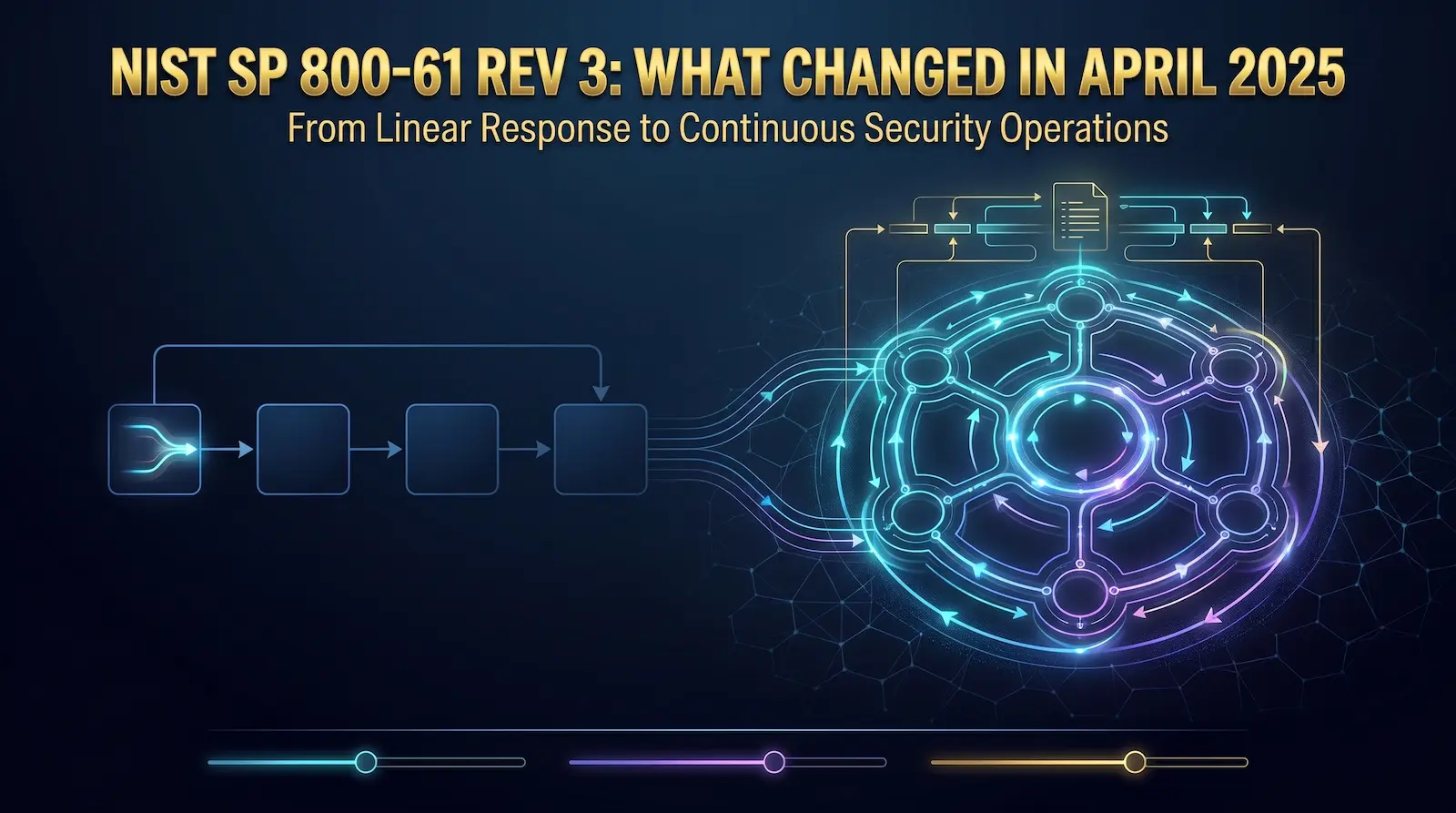
The previous version (Rev 2, published in 2012) treated incident response as a bounded, linear set of four phases. You detect an incident, you respond, you recover, you write a lessons-learned report. Done.
Rev 3 changes that model fundamentally.
Key Changes in SP 800-61 Rev 3
- Integration with CSF 2.0 Rev 3 is no longer a standalone publication. It is built as a Community Profile within the NIST Cybersecurity Framework 2.0. This means incident response is now woven into all six CSF functions: Govern, Identify, Protect, Detect, Respond, and Recover.
- Continuous Improvement Is Now Explicit The old model ended at “lessons learned.” Rev 3 treats continuous improvement as a first-class requirement, not an afterthought. Organizations are expected to test, update, and evolve their IR capabilities on an ongoing basis, not just after incidents.
- Documentation Requirements Expanded Rev 3 places stronger emphasis on written playbooks, role assignments, and pre-authorized decision trees. The goal is to eliminate real-time improvisation during an active incident.
- The Technical Detail Moved Out Because the specifics of how to perform IR change rapidly across different technologies and environments, Rev 3 deliberately moved granular technical guidance to supplemental resources. The publication itself focuses on risk management principles that apply across all environments.
If your incident response plan was written against the 2012 version, it needs a review. The core phases are similar, but the governance model and continuous-improvement requirements are materially different.
NIST vs SANS: Choosing the Right Framework
Both NIST and SANS are widely respected. Both are correct. The difference comes down to how they divide the phases and what organizations they are best suited for.
Side-by-Side Comparison
| Phase | NIST SP 800-61 Rev 3 | SANS Incident Handler’s Handbook |
| 1 | Preparation | Preparation |
| 2 | Detection and Analysis | Identification |
| 3 | Containment, Eradication, and Recovery | Containment |
| 4 | Post-Incident Activity | Eradication |
| 5 | — | Recovery |
| 6 | — | Lessons Learned |
The practical difference: NIST groups containment, eradication, and recovery into a single phase because the work often overlaps — you should not wait until containment is 100% complete before beginning to eradicate confirmed threats. SANS separates them into three distinct phases for teams that prefer a clear handoff between actions.
Which one to use:
- NIST works better for organizations subject to US federal compliance requirements, larger enterprises with defined governance structures, and teams that operate under formal risk management frameworks.
- SANS works better for smaller security teams, organizations that want clear, stage-by-stage checklists, and teams that are building their first IR program.
The honest answer is that both produce the same outcome when executed properly. Pick one, document it, and train your team on it.

The 6 Phases of Incident Response
The six phases below follow the SANS Incident Handler's Handbook model because it gives the clearest operational separation between actions. The NIST CSF 2.0 alignment is noted where relevant.
Phase 1: Preparation
Direct answer: Preparation is everything you do before an incident occurs to ensure you can respond effectively when one does.
Preparation is the most important phase and the one most organizations underinvest in. It covers:
Team and structure:
- Define your Cybersecurity Incident Response Team (CSIRT) roles (covered in detail below)
- Assign an Incident Manager, a Tech Lead, and a Communications Manager
- Document the authority matrix: who can authorize system shutdown, who notifies regulators, who speaks to the press
Tools and access:
- Deploy monitoring tools: SIEM, EDR, UEBA, and network traffic analysis
- Confirm your team has out-of-band communication channels ready — a separate encrypted messaging platform, a phone tree, or physical meet point for when primary systems go down
- Maintain an up-to-date asset inventory so you know what you are protecting
Documentation:
- Write your IRP and have it reviewed by legal, HR, and executive leadership
- Write playbooks for your highest-risk scenarios: ransomware, DDoS, data breach, insider threat
- Store hard copies in a secure, offline location
Testing:
- Run tabletop exercises at least quarterly. A tabletop is a role-playing session where a facilitator presents an attack scenario and the team talks through their response.
- Run penetration tests to find gaps before attackers do
- Time your response drills and record the metrics — this becomes your baseline for measuring improvement
Hosting-specific preparation (critical and overlooked):
- Know your hosting provider’s security incident contact process before you need it
- Confirm what your hosting SLA covers: network isolation, IP reassignment, log access, and out-of-band communication during a major incident
- At Atal Networks, our 24/7 support team can be reached immediately during a server security incident. Contact our support team here.
Phase 2: Identification
Direct answer: Identification is the process of detecting a potential incident, gathering evidence, and confirming whether a true security event has occurred.
Not every alert is an incident. This phase exists to make that determination accurately and fast.
Detection triggers fall into two categories:
Front-loaded (early warning): Threat intelligence feeds, honeypot alerts, anomalous login attempts, unusual network traffic patterns, or SIEM correlation rules that fire before damage occurs. These catch more false positives but stop attacks earlier.
Back-loaded (visible damage): Users reporting performance issues, data unavailable, ransom notes, or external researchers reporting a breach. These are more likely to be real incidents but arrive after damage has started.
The triage process:
- Collect all available data: logs, alerts, user reports, and network captures
- Determine whether the event is a false positive or a true incident
- If a true incident, classify it by severity (P1/critical, P2/high, P3/medium, P4/low)
- Activate the appropriate playbook
Key principle: Log everything from this point forward. Every action, every decision, every time-stamp. This log is your legal record, your insurance documentation, and your lessons-learned material.
Phase 3: Containment
Direct answer: Containment limits the scope of the incident to prevent it from spreading to additional systems or data.
Containment has two stages:
Short-term containment happens immediately. The goal is to stop the bleeding fast. Actions include isolating the affected system from the network, blocking the attacker’s IP addresses, disabling compromised user accounts, and activating DDoS filtering if under a volumetric attack.
Long-term containment happens while eradication is being prepared. The affected systems are kept running (or restored to a clean image) in an isolated environment so forensic investigation can continue.
Server-level containment — what this means in practice:
For VPS environments, containment often means taking a snapshot of the affected instance and spinning up a clean replacement. The compromised snapshot is preserved for forensic analysis but kept offline and off-network.
For Serveurs dédiés, containment may require a network-level shutdown at the switch port or firewall rule level. Your hosting provider can implement this at the infrastructure layer, faster than most internal teams can act.
For Serveurs nus en métal, full physical isolation may be required. This means null-routing the server’s IP at the BGP level — the server becomes unreachable from the public internet while your team investigates.
Preserve forensic integrity during containment. Do not wipe systems before capturing evidence. Memory dumps, running process lists, network connection states, and full disk images should all be captured before any remediation begins.
Phase 4: Eradication
Direct answer: Eradication removes all traces of the attack from your environment — malware, backdoors, compromised credentials, and the vulnerabilities that were exploited.
Eradication must be thorough or the attacker comes back. The most common failure in IR is believing an environment is clean when a backdoor or dormant implant is still present.
Eradication steps:
- Conduct a root cause analysis (RCA) to identify exactly how the attacker got in
- Remove all malware, ransomware payloads, and malicious scripts
- Investigate and close the exploited vulnerability (patch, configuration change, or access revocation)
- Remove all unauthorized admin accounts and SSH keys added by the attacker
- Rebuild corrupted or manipulated systems from a known-good baseline
- Update firewall rules and DNS filtering policies
- Force a full password reset for all accounts in the blast radius — and for privileged accounts across the organization as a precaution
- Rotate API keys, service account credentials, and certificates that may have been exposed
The rebuild vs restore decision: Rebuilding from scratch takes longer but guarantees a clean system. Restoring from backup is faster but only safe if the backup predates the breach and the backup itself has not been compromised. For high-severity incidents, rebuild.
Phase 5: Recovery
Direct answer: Recovery restores affected systems to normal operations safely, gradually, and with monitoring in place to confirm the threat is gone.
Recovery is not a single action. It is a controlled, staged process.
Recovery principles:
- Restore systems in order of business criticality
- Do not rush. Bringing a compromised or unstable system back online extends the incident.
- Implement enhanced monitoring on every restored system for at least 30 days
- Define explicit go/no-go criteria before bringing each system live — confirm no suspicious activity, no unexpected network connections, no unauthorized processes
Recovery stages:
- Restore from verified clean backup or rebuilt image
- Apply all security patches before connecting to the network
- Bring systems online in a staged, monitored environment first
- Validate functionality with a subset of users before full production traffic
- Scale to full production once stability is confirmed
For server environments: Your hosting provider’s role in recovery includes confirming clean IP reputation (no blacklisting from the incident), restoring BGP routing, and verifying network-level monitoring is active. At Atal Networks, our infrastructure team works alongside your security team during the recovery phase to confirm that the network layer is clean before full traffic is restored.
Phase 6: Lessons Learned
Direct answer: Lessons learned is a structured review of the incident, conducted within 14 days of full recovery, to identify what worked, what failed, and what needs to change.
NIST SP 800-61 Rev 3 explicitly requires this to be a blameless process. People will not share honest observations about failures if they fear punishment. The goal is to improve the system, not punish individuals.
The post-incident review covers:
- A complete timeline of the incident from first indicator to full recovery
- What detection worked and what was missed
- Whether the escalation protocols functioned correctly
- Whether communication (internal and external) was clear and timely
- Whether the IRP and playbooks accurately reflected what the team needed to do
- Where resources (people, tools, access) were insufficient
Outputs:
- Updated IRP and playbooks
- New or revised detection rules
- Patching or configuration changes identified during RCA
- Training recommendations for specific team members or departments
- A written report for executive leadership, legal, and (if required) regulators
What Your Hosting Provider Should Do During an Incident
This is the section no other IR guide covers. It is also the section that matters most if your business runs on cloud, VPS, or dedicated server infrastructure.
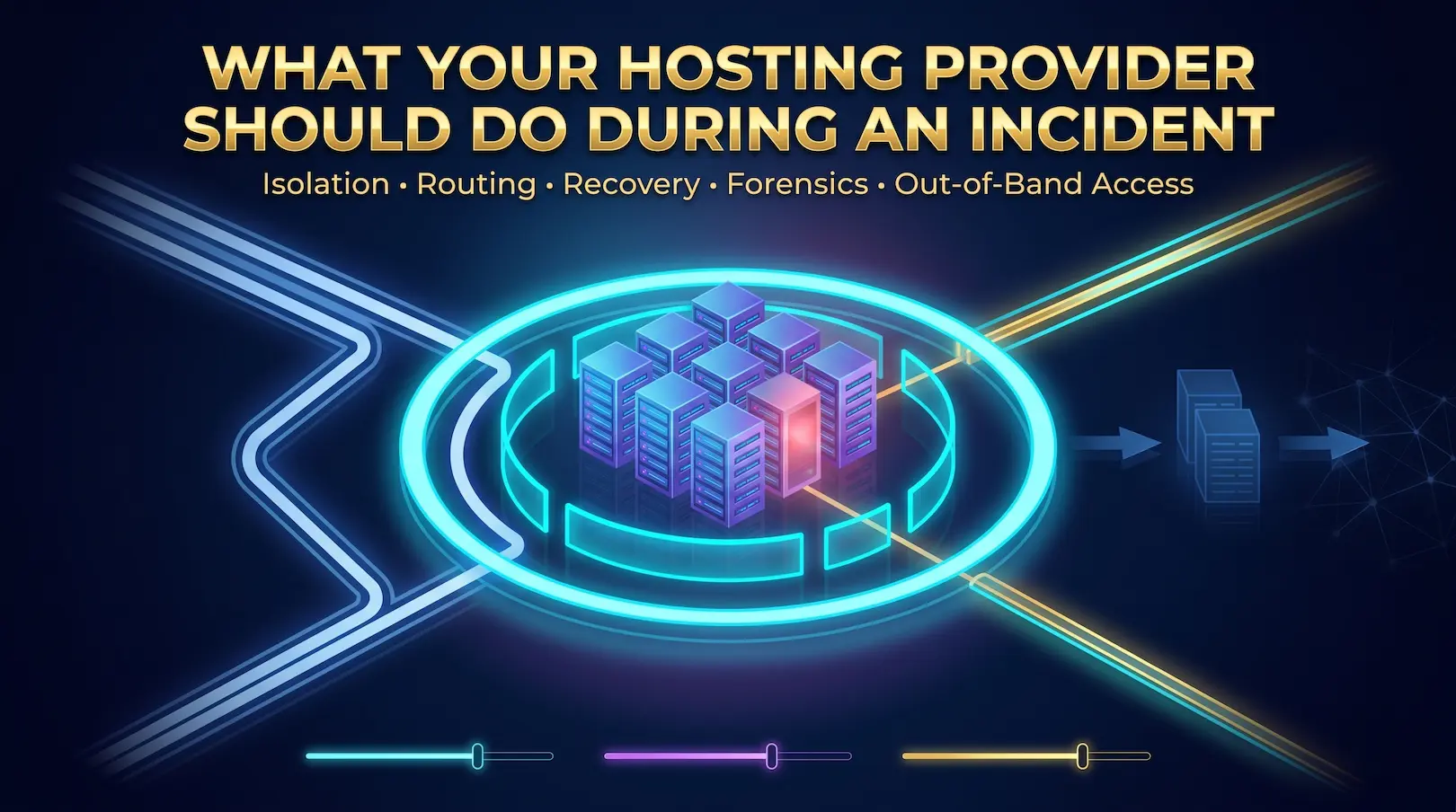
Your hosting provider is not a passive bystander during a security incident. They control your network access, your IP routing, your server hardware, and in many cases your out-of-band communication channels. A capable hosting provider is part of your incident response team.
Here is exactly what your provider should be able to do:
Network-Level Isolation
When a server is confirmed compromised, you need it cut off from the rest of the internet immediately. A good hosting provider can:
- Implement a null route at the BGP level, making the server’s IP unreachable from outside
- Apply firewall rules at the network edge, not just the server level, to block lateral movement
- Reassign your IP addresses if they are blacklisted due to outbound spam or attack traffic from the compromised server
At Atal Networks, network-level isolation can be activated immediately through our support team. We operate across 213+ data centers with BGP redundancy through Simply Transit, which means isolation and routing changes take effect at the infrastructure layer, not just the OS level.
Server Type Matters: Containment by Infrastructure
Different server types require different containment approaches. Your IRP should document which type you run and the exact containment steps for each. Not sure which server type fits your workload? See our dedicated servers vs VPS hosting comparison.
| Server Type | Containment Approach | Provider Action |
| VPS | Snapshot the instance, spin up clean replacement | Provider takes hypervisor-level snapshot, isolates the VM’s virtual network interface |
| Serveur dédié | Shut down at switch port or firewall level | Provider applies access control list (ACL) at the switch, disconnects from network fabric |
| métal nu | Full IP null-route + out-of-band console access | Provider null-routes BGP, provides IPMI/iDRAC access for remote investigation |
| Colocation | Physical access coordination | Provider controls network interconnects, coordinates access for your team or third-party IR firm |
Out-of-Band Communication During an Incident
This is the most overlooked piece of IR planning. If your primary systems are down — email is down, Slack is down, your VPN is down — how does your team communicate and coordinate?
A serious hosting provider gives you out-of-band access through:
- IPMI (Intelligent Platform Management Interface): Console-level access to your server hardware independent of the operating system. If the OS is compromised, you can still see what is happening and issue commands.
- iDRAC / iLO: Manufacturer-level remote management cards that work even when the server is powered off or the OS has crashed.
- Dedicated support channel: A phone number or emergency ticket system that bypasses standard ticketing queues during a confirmed incident.
If your hosting provider cannot offer out-of-band access to your servers, that is a serious gap in your incident response capability.
Log Retention and Forensic Data
After an incident, you will need logs. Network traffic logs, access logs, authentication logs, DNS query logs. Your hosting provider may hold infrastructure-level logs that your internal systems do not capture.
Before an incident happens, confirm with your hosting provider:
- What logs are retained at the infrastructure level
- How far back the retention window goes (30 days, 90 days, longer)
- In what format logs are delivered for forensic analysis
At Atal Networks, we retain infrastructure-level logs and can provide them to customers during a confirmed security incident. Our support team coordinates directly with your IR team or your external IR firm.
How to Notify Your Hosting Provider
The moment you confirm a security incident affecting your hosted infrastructure, open a support ticket immediately, and mark it as a security emergency. Do not wait until containment is complete.
Information to include in your notification:
- Confirmation that a security incident is in progress
- Which servers or IPs are affected
- Whether you need network isolation, log access, or out-of-band console access
- Your on-call contact details for the duration of the incident
Contact Atal Networks 24/7 Support — our team is available around the clock and treats security incidents as priority escalations.
Building Your Incident Response Team (CSIRT)
A Cybersecurity Incident Response Team (CSIRT) is the group responsible for executing your IR plan when an incident occurs. Every member has a defined role before the incident happens.
Core Roles
Incident Manager (IM) The IM leads the response. They manage communication flows, update stakeholders, delegate tasks to other team members, and track the clock. Critically, the IM does not perform technical work during the incident. Their job is coordination and decision-making. In a crisis, time dilation is real — people lose track of how long things are taking. The IM monitors the clock and keeps the team on track.
Tech Lead (TL) The TL serves as the technical subject matter expert. They direct containment, eradication, and recovery actions, bring in additional technical specialists as needed, and make the call on rebuild vs restore decisions. The TL coordinates with your hosting provider’s infrastructure team.
Communications Manager (CM) The CM manages all internal and external communications during the incident. Internal updates to employees and executive leadership. External communications to customers, regulators, and the media. The CM also prepares holding statements in advance — pre-approved language for scenarios like a reporter calling about a suspected breach.
Legal Counsel Legal must be involved from the moment a breach is confirmed, especially when personal data may be involved. They advise on regulatory notification timelines (GDPR: 72 hours, HIPAA: 60 days), evidence handling requirements, and what can and cannot be shared externally.
Executive Sponsor A senior executive with the authority to make business-level decisions during an incident. This includes authorizing system shutdowns that affect revenue, approving communications, and deciding whether to engage law enforcement.
When to Bring in External IR Firms
External IR firms bring pre-built playbooks, experienced responders, and forensic tooling that most internal teams do not have. Consider engaging one when:
- The incident severity is P1 (ransomware, data exfiltration, complete system compromise)
- Your internal team lacks experience with the specific attack type
- You need independent forensic evidence for legal or insurance purposes
- The incident is large enough to overwhelm your internal capacity
Select your external IR firm before an incident happens. Pre-negotiating a retainer is far better than searching for a firm while under attack.
Running a Tabletop Exercise
A tabletop exercise is a role-playing session where a facilitator presents an attack scenario and the team talks through their response in real time. No actual systems are involved. The value is in finding gaps in your plan and decision-making before they matter.
A basic tabletop format:
- Facilitator presents scenario: “Your monitoring system just flagged unusual outbound traffic from three servers. It’s 2 AM on a Sunday.”
- Team discusses: who gets called first, what actions are taken, what information is needed
- Facilitator injects new developments: “The servers are confirmed compromised. Ransomware has been deployed.”
- Team continues response
- Post-exercise debrief: what worked, what did not, what gaps were found
Run tabletops at least twice a year. Run them after every significant incident or major infrastructure change.

IR Procedures for Common Attack Types
Your general IRP covers the six phases. Your playbooks cover specific attack types. Here are the key decisions and actions for the four most common scenarios.
Ransomware
Ransomware is the highest-priority incident type for most organizations. Speed of containment directly determines how much data is encrypted.
The pay or not pay decision: Law enforcement agencies including the FBI recommend not paying ransoms. Payment does not guarantee data recovery, funds criminal operations, and may violate OFAC sanctions if the threat actor is on a blocked list. The better position is a tested, segmented backup strategy that makes payment unnecessary.
Critical actions:
- Isolate affected systems immediately at the network level (your hosting provider can do this)
- Do not restart affected systems — memory forensics may reveal the attacker’s tools
- Identify the ransomware variant to determine if a free decryption key exists (check nomoreransom.org)
- Notify your cyber insurance carrier immediately
- Engage law enforcement — the FBI’s Internet Crime Complaint Center (IC3) collects ransomware reports and may have intelligence on the specific threat actor
DDoS Attacks
Distributed Denial of Service attacks target availability. The response is at the network layer, which makes your hosting provider a primary responder, not just a support resource.
Hosting-provider response actions:
- Activate DDoS filtering and traffic scrubbing at the network edge
- Apply rate limiting and traffic shaping to absorb or redirect attack volume
- Implement IP-based blocking for confirmed attack sources
- Engage upstream transit providers for traffic blackholing if the attack exceeds scrubbing capacity
Internal actions:
- Activate your CDN’s DDoS protection layer
- Enable application-layer rate limiting on your web servers
- Communicate estimated service restoration time to affected customers
- Log all attack traffic for post-incident analysis
At Atal Networks, our BGP network with Simply Transit routing includes DDoS mitigation capabilities. See our bare metal server infrastructure for details on what is covered at the infrastructure level.
Data Breach
When personal data may have been exposed, the clock starts for regulatory notification.
Notification timelines:
- GDPR: 72 hours to notify the relevant supervisory authority after becoming aware of the breach
- HIPAA: 60 days from discovery to notify the HHS Office for Civil Rights
- State breach laws (US): Vary by state, ranging from 30 to 90 days
Critical actions:
- Preserve all evidence before any remediation
- Determine the scope of exposure: what data, how many individuals, what categories
- Engage legal counsel immediately
- Draft customer and regulatory notifications — do not send without legal review
- Document every action taken with timestamps for regulatory reporting
Insider Threat
Insider threats are among the hardest to detect and the most sensitive to handle because they involve employees, contractors, or partners.
Key differences in response:
- HR and legal must be involved from the first indication
- Evidence collection must follow proper chain-of-custody procedures for potential legal proceedings
- Communication about the investigation is restricted to a need-to-know group
- Access revocation must be coordinated carefully to avoid alerting the subject before evidence is secured
Incident Response and Compliance
Regulatory compliance frameworks do not just recommend IR plans. Several require them explicitly, with specific documentation and testing obligations.
| Framework | IR Requirement |
| NIST CSF 2.0 | Respond and Recover functions require documented IR capabilities — see NIST’s incident response guidance |
| ISO 27035 | International standard specifically for information security incident management |
| GDPR | Article 33: breach notification within 72 hours, documented procedures required |
| HIPAA | Security Rule requires documented incident response procedures and workforce training |
| PCI DSS | Requirement 12.10: documented IR plan, annual testing, 24/7 response capability |
| SOC 2 | Incident response is a core availability and security trust service criterion |
For organizations subject to multiple frameworks, a single well-documented IRP aligned to NIST SP 800-61 Rev 3 covers most requirements. The key is documentation, testing evidence, and regular updates.
Incident Response Checklist
Use this checklist during an active incident. Print it and keep a copy offline.
Preparation (Pre-Incident)
- [ ] IRP documented and approved by legal, HR, and executive leadership
- [ ] CSIRT roles assigned with named backups for each role
- [ ] Playbooks written for ransomware, DDoS, data breach, and insider threat
- [ ] Out-of-band communication channels tested and confirmed working
- [ ] Hosting provider’s emergency security contact confirmed and stored offline
- [ ] Backup integrity verified — last test date: ___________
- [ ] Tabletop exercise completed — last date: ___________
- [ ] External IR firm retainer in place (if applicable): ___________
Detection and Identification
- [ ] Alert received or incident reported: time: ___________
- [ ] Initial triage completed — false positive or true incident confirmed
- [ ] Incident severity classified: P1 / P2 / P3 / P4
- [ ] Incident Manager notified: time: ___________
- [ ] Incident log opened and running
- [ ] Appropriate playbook activated
Containment
- [ ] Affected systems identified and inventoried
- [ ] Network isolation implemented (internal + provider level)
- [ ] Compromised accounts disabled
- [ ] Forensic evidence captured before remediation begins
- [ ] Hosting provider notified (if server infrastructure affected): time: ___________
- [ ] Law enforcement notified (if required): time: ___________
- [ ] Legal counsel engaged: time: ___________
Eradication
- [ ] Root cause analysis completed
- [ ] All malware and unauthorized access tools removed
- [ ] Exploited vulnerability patched or mitigated
- [ ] Unauthorized accounts and credentials removed
- [ ] Password reset initiated for affected accounts
Recovery
- [ ] Recovery plan documented with prioritized system list
- [ ] Backup integrity verified before restoration
- [ ] Systems restored and validated before returning to production
- [ ] Enhanced monitoring active on restored systems
- [ ] Hosting provider confirmed clean IP reputation and network routing
Post-Incident
- [ ] Lessons-learned meeting scheduled (within 14 days): date: ___________
- [ ] IRP and playbooks updated based on findings
- [ ] Regulatory notifications sent (if required): date: ___________
- [ ] Executive and board briefing completed
- [ ] Incident report filed with insurance carrier (if applicable)
Real-World Case Study: St. Paul Ransomware Attack (2025)
In July 2025, the City of St. Paul, Minnesota, was hit by a coordinated ransomware attack that disrupted government services across the city. The response demonstrated both what works and what organizations should prepare for in high-severity incidents.
The timeline:
- July 25: Suspicious activity detected on city networks. IT team begins investigative triage immediately.
- July 27: Malicious behavior confirmed. City IT shuts down all information systems proactively to prevent further spread.
- Following days: FBI engaged for containment and forensic investigation. Minnesota National Guard cyber assets activated by the Governor.
What worked:
- Early detection: The initial alert on July 25 gave the team two days before they made the shutdown decision. That detection window was critical.
- Isolation over payment: St. Paul chose not to pay the ransom. Instead, they implemented defensive isolation and systematic recovery, which limited financial loss and reduced the incentive for future attacks.
- Government partnerships: Engaging the FBI and National Guard brought resources and forensic capability that the city’s internal team alone could not provide.
- Large-scale credential reset: Approximately 3,500 employee accounts were reset as part of the recovery, requiring physical coordination to manage the process securely.
The lesson: No organization is too large or too well-resourced to be hit. The difference between a manageable incident and a catastrophic one is the existence of a tested IR plan, clear authority to act, and the relationships (with law enforcement, with your hosting provider, with an external IR firm) established before the attack arrives.
How AI Is Changing Incident Response in 2026
Artificial intelligence is changing IR in two directions simultaneously: it is making automated detection and response faster, and it is making attacks more sophisticated and harder to catch.
AI-Powered Detection and SOAR
Security Orchestration, Automation, and Response (SOAR) platforms now use machine learning to correlate alerts across multiple security tools, prioritize genuine threats, and execute pre-approved response actions automatically — without waiting for a human to review each alert.
UEBA (User and Entity Behavior Analytics) platforms build baseline models of normal behavior for every user and device on your network. Deviations from that baseline — a user downloading 50GB at 3 AM, a service account accessing systems it has never touched — trigger alerts that rule-based systems miss entirely.
XDR (Extended Detection and Response) platforms consolidate endpoint, network, identity, and cloud telemetry into a single detection surface, giving IR teams visibility that was previously impossible without multiple separate tools.
The False Positive Problem
AI-driven detection generates more alerts. More alerts means more triage work. The triage burden on human IR teams has increased significantly as AI tools become more sensitive.
A mature IR program in 2026 invests as much in false positive reduction as it does in detection capability. Poorly tuned detection rules that fire on benign activity waste response capacity and — more dangerously — train teams to ignore alerts. That is exactly the pattern that lets real incidents slip through.
AI-Powered Attacks
The same AI capabilities available to defenders are available to attackers. AI is being used to write more convincing phishing emails, identify targets more efficiently, adapt malware to evade detection, and automate reconnaissance. The sophistication of attacks is increasing faster than most IR programs are evolving.
The practical implication: IR plans need to account for faster attack progression. The window between initial access and full compromise is shorter than it was two years ago. Detection speed and containment speed matter more than ever.
Questions fréquemment posées
What are the 6 steps of incident response?
The six steps of incident response are: (1) Preparation — building your team, tools, and plans before an incident occurs; (2) Identification — detecting and confirming that a security incident has taken place; (3) Containment — isolating affected systems to stop the incident from spreading; (4) Eradication — removing all traces of the attacker and closing exploited vulnerabilities; (5) Recovery — restoring systems to normal operation safely and with monitoring in place; (6) Lessons Learned — conducting a post-incident review within 14 days to improve your processes.
What is the difference between NIST and SANS incident response frameworks?
NIST SP 800-61 consolidates containment, eradication, and recovery into a single phase because the work often overlaps. SANS separates them into three distinct phases for teams that prefer clear stage-by-stage handoffs. Both frameworks cover the same core activities. NIST is better suited for organizations under US federal compliance requirements or with formal governance structures. SANS works better for smaller teams building their first IR program.
How long should an incident response plan be?
An IRP should be long enough to be complete and short enough to be read under pressure. Most effective IRPs are 10 to 30 pages for the core document, with separate playbooks for each attack type. A plan no one reads during a crisis is not a plan — it is a document. Keep the core IRP concise and put the operational detail in the playbooks.
What does a hosting provider do during a server security incident?
A capable hosting provider can take several critical actions during a security incident: implementing network-level isolation by null-routing your server’s IP at the BGP level, providing out-of-band console access (IPMI/iDRAC) for investigating a compromised server without relying on the compromised OS, activating DDoS filtering and traffic scrubbing, providing infrastructure-level logs for forensic analysis, and coordinating IP reputation restoration during recovery. At Atal Networks, our 24/7 support team treats security incidents as priority escalations and coordinates directly with your IR team or external IR firm. Contact our team here.
How often should you test your incident response plan?
Your IRP should be reviewed and updated at minimum once per year. Tabletop exercises should run at least twice per year — and immediately after any significant incident or major infrastructure change. Full simulated exercises (red team vs blue team, or penetration tests against specific attack scenarios) should run at least annually. The goal is never to let your IRP become a document that only existed on paper.
What is NIST SP 800-61 Rev 3?
NIST SP 800-61 Revision 3 is the current version of the National Institute of Standards and Technology’s incident response guidance document, published in April 2025. It updates the previous 2012 version (Rev 2) by integrating incident response into the NIST Cybersecurity Framework 2.0, introducing a new Community Profile for cyber incident risk management, and placing stronger emphasis on continuous improvement, documentation, and governance. It is the most widely referenced incident response framework in US federal and enterprise environments.
Final Word
Incident response procedures are not a compliance checkbox. They are the difference between a security incident that costs you a few hours and one that costs you millions of dollars, customer trust, and months of recovery work.
The organizations that handle incidents well are not the ones with the best tools. They are the ones that prepared, documented, trained, and tested before the attack arrived.
And one more thing: your hosting infrastructure is part of your IR plan whether you have thought about it that way or not. A provider that can isolate a compromised server at the network level, give you out-of-band console access, and coordinate with your team at 2 AM is worth thinking about before you need them.
At Atal Networks, we run Serveurs VPS, Serveurs dédiés, et bare metal infrastructure across 213+ data centers worldwide. Our team is available 24/7 for security incidents. If you are reviewing your IR plan and want to understand how your hosting infrastructure fits into it, reach out to our support team — we are happy to walk through your setup.
Published by Atal Networks — global hosting provider serving 36,000+ clients across 196 countries with dedicated servers, VPS hosting, bare metal infrastructure, and 24/7 expert support.