 Перейти к содержимому









Attackers hit Change Healthcare with ransomware in January 2024. One stolen login gave them access to the entire internal network. They moved freely from system to system, located critical infrastructure, and encrypted it. The cleanup cost $22 billion. Over 100 million patients lost their personal health records.
Security experts reviewed the incident and reached the same conclusion: proper network segmentation would have stopped the damage at a single zone. The stolen credentials would still have caused a breach. The difference is that the breach would have stayed in one isolated corner of the network rather than spreading to everything.
That outcome captures the purpose of network segmentation. It does not stop every attack from starting. It stops attacks from spreading after they start.
This guide covers the full definition, all four major types, the seven measurable benefits, and a seven-step implementation framework, with a specific focus on dedicated server environments.
Содержание
- Network Segmentation: The Plain Definition
- The Real Problem With a Flat Network in 2026
- The Four Types of Network Segmentation
- 7 Reasons Network Segmentation Matters
- Network Segmentation in Five Real Scenarios
- 7-Step Framework for Implementing Network Segmentation
- Network Segmentation and Zero Trust: The Correct Relationship
- Network Segmentation for Dedicated Server Environments
- 5 Segmentation Mistakes That Give a False Sense of Security
- Часто задаваемые вопросы
- Build a Network That Contains Failures
Network Segmentation: The Plain Definition
Network segmentation splits one large computer network into smaller, isolated sections called segments or subnets. Each segment runs independently with its own security policies and traffic controls. Devices in one segment cannot communicate freely with devices in another. All traffic trying to cross between segments must pass through a controlled checkpoint, typically a firewall or access control list, where explicit rules either permit or block the communication.
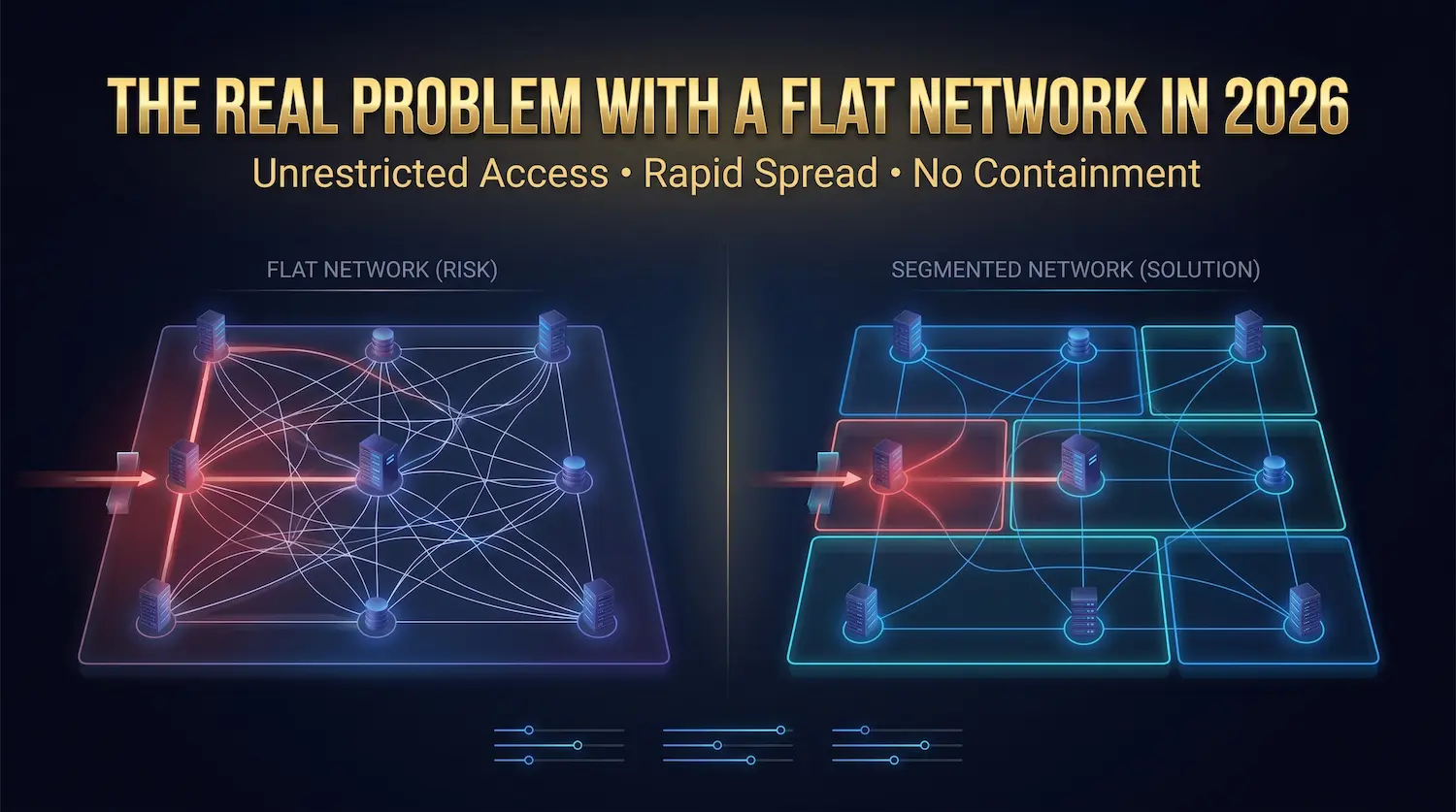
The opposite of a segmented network is a flat network. A flat network connects all devices to one shared space with no internal separation. Every device talks directly to every other device without any restrictions.
A useful comparison: a flat network is one large open room. A segmented network is a building with separate locked rooms. Entering the building does not hand someone the key to every room.
Key terms used throughout this guide:
Segment or subnet: A section of the network that runs separately, with its own IP address range and security rules.
Lateral movement: The technique attackers use after an initial breach to move from one compromised device to other systems inside the same network.
Blast radius: The total amount of damage a breach causes before security controls stop its spread.
East-west traffic: Data moving between servers, applications, and devices inside the network. Most attack damage travels along these internal paths after the first compromise.
North-south traffic: Data moving between the internal network and external networks. Traditional perimeter firewalls focus on this traffic type.
DMZ (Demilitarized Zone): A dedicated segment that holds internet-facing services like web servers and email gateways, fully isolated from internal systems.
VLAN (Virtual Local Area Network): A software-based method for creating separate segments on shared physical hardware, built on the IEEE 802.1Q standard.
These terms carry one meaning throughout this document, consistent with Word Sense Disambiguation (WSD) principles. Every technical term refers to the same concept each time it appears.
The Real Problem With a Flat Network in 2026
Most networks were built around one security assumption: keep attackers out of the perimeter, and internal traffic stays safe. That assumption failed years ago. The 2026 threat landscape makes running a flat network more dangerous than at any prior point.
Attackers move faster than most security teams can respond. Current threat intelligence shows attackers reach critical systems within 72 minutes of initial access, four times faster than a few years ago. AI-powered tools automate reconnaissance, privilege escalation, and target identification with no human direction required. On a flat network, 72 minutes is enough time to map every high-value system, locate backups, destroy them, and stage the ransomware.
Most modern attacks use no malware. According to CrowdStrike's 2026 Global Threat Report, 82% of cyberattacks in 2026 involved no malware files, up from 40% a few years ago. Attackers steal credentials through phishing, purchase them from data brokers, or pull them from infostealer logs. They log into the network using those credentials and operate with the same tools that real administrators use: SSH, RDP, Windows Management Instrumentation (WMI), and SMB. Standard antivirus software cannot detect this. It looks like normal activity.
On a flat network, one stolen low-privilege credential can eventually reach a payment database. The attacker just needs time and open paths between systems.
Ransomware kills backups before announcing itself. CISA’s ransomware guidance documents a repeating pattern: attackers locate and destroy backup systems during their dwell period, before anyone knows they are inside. On a flat network, the backup server sits next to the web server with an open path between them. The attacker destroys the recovery option, then deploys the ransomware.
The historical proof is already on record. In 2017, WannaCry spread across flat networks through the SMB protocol to 200,000 machines across 150 countries in under 72 hours. In 2021, Colonial Pipeline shut down 5,500 miles of fuel pipeline serving the eastern United States because insufficient segmentation between IT and operational technology (OT) networks made containment impossible. Both attacks started from a single entry point. Both traveled freely through flat architecture. Both would have been containable with proper segmentation in place.
The Four Types of Network Segmentation
Physical Segmentation
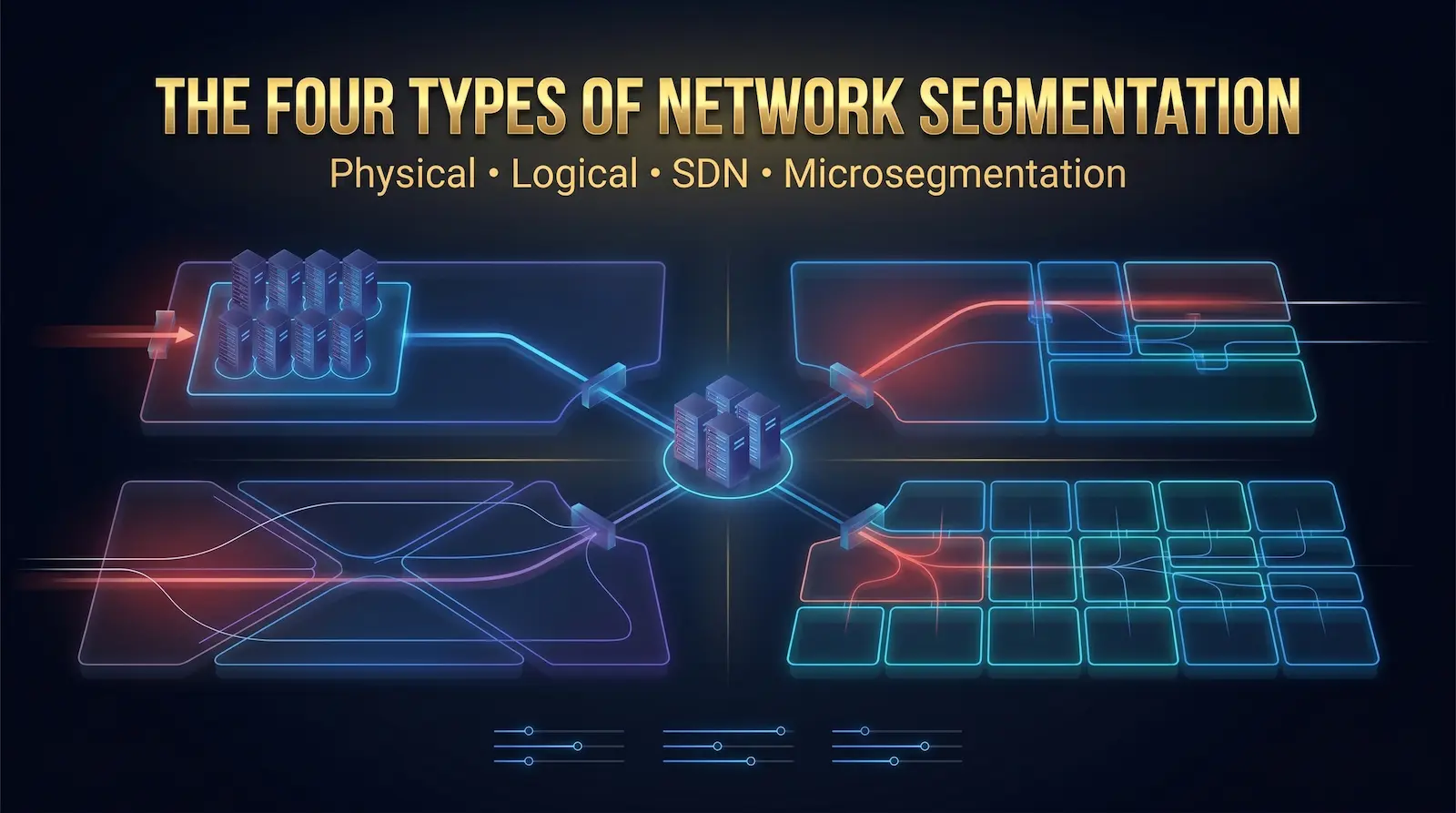
Physical segmentation uses completely separate hardware for each network section: distinct switches, cables, routers, and firewalls. All traffic moving between sections must travel through a physical gateway device. No software configuration error can accidentally create a path between sections.
Best for: Operational technology (OT) networks, government classified systems, or high-stakes payment environments where regulations require physical isolation.
Trade-off: Maximum security with zero accidental cross-zone paths, but expensive, inflexible, and difficult to scale. Adding a new section requires new hardware.
Logical Segmentation Using VLANs and Subnetting
Logical segmentation creates isolated zones in software on shared physical hardware. This is the standard approach for businesses running выделенные серверы.
VLANs use the IEEE 802.1Q standard to tag traffic with zone IDs. Switch ports in one VLAN cannot talk to ports in another VLAN without routing through a firewall. One physical switch can host dozens of isolated logical networks at the same time.
Subnetting assigns devices to different IP address ranges. Traffic between subnets routes through a gateway that enforces defined access rules.
Sample VLAN layout for a dedicated server environment:
VLAN 10: DMZ (Web Servers, Public APIs)
VLAN 20: Application Tier (App Servers, APIs)
VLAN 30: Database Tier (MySQL, PostgreSQL, Redis)
VLAN 40: Management Zone (Admin Access Only)
VLAN 50: Backup Zone (No Production Access)
VLAN 60: Guest and IoT (No Internal Access)
Best for: Most businesses. It runs on existing hardware, is cost-effective, and adjusts easily as infrastructure grows.
Software-Defined Segmentation (SDN)
Software-Defined Networking (SDN) moves segmentation policy away from physical hardware and into a central controller. The controller manages all zones programmatically and pushes policy updates across the entire network in seconds.
Best for: Cloud environments and hybrid infrastructure where IP addresses change constantly as workloads move between hosts.
Microsegmentation
Microsegmentation applies security policies at the individual workload level. Rather than zones covering many servers, policies apply to a single virtual machine, container, or application process. A rule might state: “This PostgreSQL container accepts inbound connections only from this specific Python application container on port 5432. All other connections are denied.”
Best for: Protecting high-value workloads, cloud-native environments, and Zero Trust architectures.
The key distinction between network segmentation and microsegmentation: Network segmentation primarily controls north-south traffic between external networks and internal zones. Microsegmentation primarily controls east-west traffic between systems inside those zones. Both layers are needed because they cover different parts of the attack path.

7 Reasons Network Segmentation Matters
Ransomware stays in one zone
On a flat network, ransomware executing on a compromised web server reaches databases, file servers, and backup storage within minutes. On a segmented network, the ransomware runs in one zone and cannot cross the firewall boundary into other zones. The affected zone gets restored from backups that survived because the attacker never had a path to them.
Stolen credentials lose most of their value
1.8 billion credential sets were stolen in the first half of 2025 alone. On a flat network, one stolen admin login can reach everything. On a segmented network, that credential reaches only its assigned zone. The attacker needs separate, valid credentials for each additional zone. This makes credential-based attacks exponentially harder to execute at scale.
Compliance scope shrinks by up to 80%
Every major data regulation treats network segmentation as a required technical control.
The PCI Security Standards Council requires that cardholder data environments be isolated from all other network systems. Without that isolation, the entire network enters PCI DSS compliance scope. Proper segmentation cuts that scope by up to 80%.
HIPAA requires technical isolation of electronic Protected Health Information (ePHI) from general systems. GDPR Article 32 requires “appropriate technical measures” proportional to risk. ISO 27001 Control A.13.1.3 requires network segregation directly. Segmentation satisfies all four at the architectural level.
Backup systems survive
Ransomware operators target backup systems before deploying encryption because destroying recovery options forces victims to pay. On a flat network, production servers can initiate connections to backup servers, giving ransomware a path to the backups. On a segmented network, the backup zone accepts incoming backup traffic but blocks any connection that a production system initiates toward it. The backups stay intact.
Breach detection gets faster
A web server attempting to open a direct database connection generates an immediate alert on a segmented network, because that action violates the firewall rule between those zones. On a flat network, lateral movement blends into the regular stream of administrative traffic. No alert fires because the traffic looks legitimate. Segmentation turns unexpected lateral movement into an automatic, logged event.
Network performance improves
Broadcast traffic, including ARP requests, DHCP announcements, and routing protocol updates, stays within each zone rather than flooding every device on the entire network. High-bandwidth tasks like database replication and backup jobs run in dedicated zones and stop competing with production application traffic for bandwidth. The result is a faster, less congested network overall.
Zero Trust gets a real enforcement layer
Zero Trust security operates on one principle: never trust any request by default, regardless of source. “Inside the network” grants no automatic trust. Network segmentation provides the structural layer that makes this principle work in practice.
Without zones, a Zero Trust policy verifies a user at login and then has no architectural mechanism to stop that user from moving freely through a flat internal network. With zones, each boundary point enforces the policy. The verified user only reaches their assigned zone. Zero Trust becomes a real operational control rather than a stated philosophy.
Network Segmentation in Five Real Scenarios
Scenario 1: Dedicated Server Infrastructure
An e-commerce company runs web servers, application servers, databases, and admin tools across выделенные серверы. A SQL injection attack against the web server tier compromises the DMZ. On a flat network, the attacker pivots directly to the database. On a properly segmented network, a firewall boundary separates the DMZ from the application tier, and another boundary separates the application tier from the database tier.
Each boundary requires specific credentials and valid firewall rules. Each failed crossing attempt generates a log entry. The attacker stalls at the first boundary while alerts trigger.
Typical segmented architecture:
[Internet] > [DDoS Layer] > [DMZ: Web Servers]
> [App Tier: Application Servers]
> [Data Tier: Databases, Backups]
> [Management Zone: VPN + MFA only]
Scenario 2: Healthcare Networks (HIPAA)
Healthcare environments carry ePHI alongside administrative systems and medical devices, many running unpatched operating systems from a decade ago. A segmented healthcare network places clinical systems, medical imaging devices, administrative tools, and vendor access points in separate zones.
A compromised imaging device stays in the medical device zone with no direct path to the clinical database. Our compliance infrastructure supports HIPAA isolation requirements across dedicated data center environments.
Scenario 3: Retail and E-Commerce (PCI DSS)
Without segmentation, every device in the business enters the PCI DSS compliance scope. With a properly defined payment zone, only the systems that handle card data carry that requirement. POS terminals sit on a dedicated payment VLAN. Customer WiFi connects to an isolated guest segment with no access to business systems.
Scenario 4: SaaS Platforms
Development environments must not reach production databases. Staging must not expose real customer data. Separate zones for each environment make these requirements enforceable at the network layer, not just at the application level. A compromised developer workstation stays in the development zone. CI/CD pipelines connect environments through audited, automated pathways only. See available infrastructure options in our VPS hosting overview.
Scenario 5: IoT and Mixed Device Environments
Security cameras, HVAC systems, printers, and badge readers run old firmware with no security software and no patch schedule. Placing these devices in a dedicated IoT VLAN lets them connect to the internet for updates while blocking any path to internal production systems. A compromised camera stays in the IoT zone with nowhere internal to go.
7-Step Framework for Implementing Network Segmentation
Step 1: Map every device and its communication needs
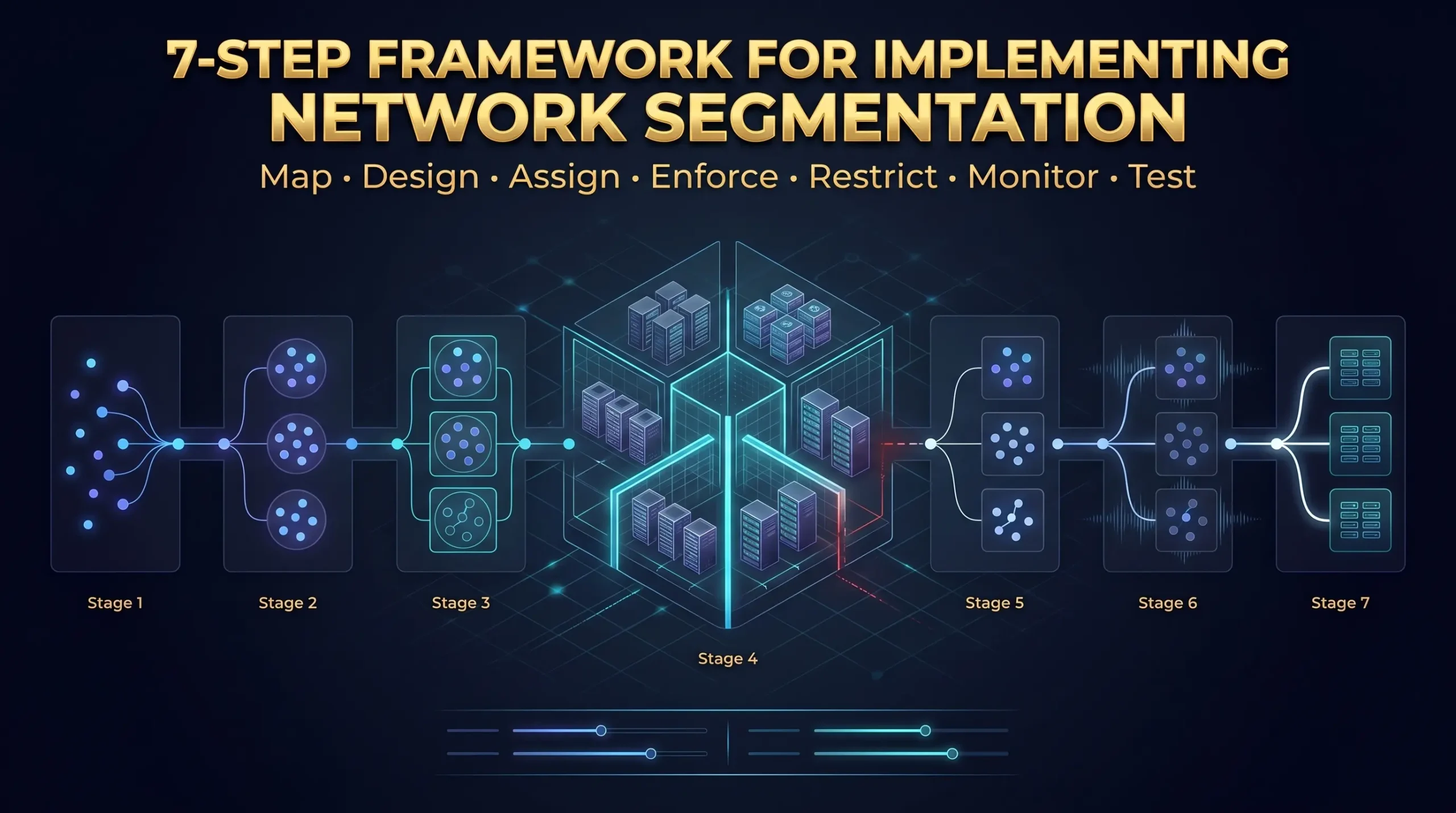
List every server, workstation, IoT device, and application. Classify each by sensitivity: public-facing, internal, sensitive (payment or health data), or critical (databases, backups, admin consoles). Map the communication dependencies: which systems need to talk to which others and for what exact reason.
Skipping this step causes the most common implementation failure: segmenting systems that must communicate with each other and breaking live applications in the process.
Step 2: Define the security zones
| Zone | Contents | External Access |
| DMZ | Web servers, public APIs, and email gateways | Да |
| Application Tier | App servers, microservices, APIs | Не |
| Data Tier | Databases, file storage | Не |
| Управление | Admin consoles, monitoring tools | VPN + MFA only |
| Backup Zone | Backup systems, recovery storage | Не |
| User Zone | Employee workstations | Filtered |
| Guest and IoT | Guest WiFi, IoT devices | Internet only |
| Payment Zone | POS terminals, card processors | PCI-controlled |
Step 3: Assign VLANs and subnets
Give each zone a unique VLAN ID and a dedicated subnet. Configure inter-VLAN routing only where business requirements explicitly justify it. The default setting is full isolation. Zones remain separated until a documented business need creates a controlled, rule-based connection between them.
Step 4: Build firewall rules starting from deny all.
Start with a full line between every pair of zones. Then add specific allowed rules for each justified traffic path.
Sample rules for DMZ to Application Tier:
ALLOW: TCP from DMZ web servers to App servers on port 8080
ALLOW: TCP from App servers to DMZ web servers on ports 80, 443
DENY: All other traffic
Each allow rule needs a written justification, a creation date, and a named owning team. Rules without documentation become invisible attack paths over time as staff changes and memories fade.
Step 5: Apply least-privilege to every connection path
Each service gets only the network access it requires. Web servers do not connect directly to databases. Databases do not initiate outbound connections to the internet. Any connection path without a clear business reason belongs off the allow list.
Step 6: Set up logging and alerting at every zone boundary
Every cross-zone connection attempt, permitted or denied, must produce a log entry. Connect those logs to your central network security monitoring platform. Set alerts on deviations: a web server probing database ports, a backup server opening outbound connections, or admin-level traffic coming from a non-management zone.
Segmentation without active monitoring is incomplete. Zone boundaries without logging tell you nothing about how attackers are probing your architecture.
Step 7: Test every boundary actively before going live
Run connection tests from each zone:
- From the DMZ, attempt to connect to the database ports. The attempt must fail.
- From the application tier, attempt to reach the management zone. The attempt must fail.
- From the guest and IoT zone, attempt to reach any production system. Every attempt must fail.
- From the database tier, attempt any outbound internet connection. The attempt must fail.
Repeat this testing after every significant infrastructure change. Networks shift over time, and segmentation degrades silently without regular verification. Contact our security team to run formal penetration tests targeting zone boundary crossing.
Network Segmentation and Zero Trust: The Correct Relationship
Zero Trust operates on one principle: never trust any user, device, or request by default, regardless of network location. “Inside the network” grants no automatic trust.
Network segmentation provides the physical structure that gives Zero Trust teeth at the network layer.
Without segmentation, Zero Trust verifies a user at login. After that, the authenticated user moves freely through a flat internal network with no architectural constraint on where they go. The verification happened once. The access has no limit.
With segmentation, zone boundaries enforce the policy at each crossing point. A verified identity reaches only its assigned zones. A compromised account stays confined to one segment. Another breach of trust is required to cross into the next zone.
Microsegmentation extends this further by placing Zero Trust enforcement at the individual workload level. Every application-to-application connection requires separate authorization. An attacker who compromises one container cannot reach adjacent containers without distinct, valid authorization for each.
In 2026, with 82% of attacks running on stolen credentials and legitimate tools, this combination represents the most reliable network defense model available. Zero Trust sets the policy. Segmentation makes that policy real.
Network Segmentation for Dedicated Server Environments
Dedicated server clients carry the full weight of network security. A managed cloud provider handles the baseline isolation between its customers. A dedicated server environment gives the client full control and full responsibility for implementing proper segmentation.
Atal Networks infrastructure support:
Private network connectivity between Atal Networks’ dedicated servers keeps inter-zone traffic off the public internet. Traffic between your application tier and database tier travels through private interfaces rather than internet-routed paths, reducing the exposure window for any cross-zone connection.
Network-level 40 Gbit/s DDoS protection covers traffic hitting the DMZ zone, so high-volume attack traffic does not saturate the bandwidth that internal zone communication depends on. Upstream scrubbing absorbs attack packets before they reach the server infrastructure.
213+ global data center locations support geographic segmentation for compliance requirements. GDPR data residency, HIPAA geographic restrictions, and data sovereignty rules get addressed by placing workloads in specific geographic zones while maintaining private network connectivity between them.
Two gaps that dedicated server clients commonly miss:
Management interfaces, including IPMI and KVM-over-IP, must sit in a dedicated management VLAN accessible only through a VPN with multi-factor authentication. These interfaces provide hardware-level server access. An exposed IPMI port can give an attacker physical-level control over the server. Our network security guide covers management interface hardening in full.
Backup systems need complete zone isolation from production environments. A backup server that production systems can initiate connections to is a backup server that ransomware can reach. The backup zone must accept incoming backup traffic from production zones and block all reverse connections.
5 Segmentation Mistakes That Give a False Sense of Security
Mistake 1: Creating VLANs without logging them. VLANs with no monitoring provide no visibility. Every zone boundary needs active logging and alerting before it delivers real security value.
Mistake 2: Keeping the management plane on the same network as production. A compromised workstation with access to admin consoles can control every server in the environment. The management zone must be the most tightly restricted zone in the architecture.
Mistake 3: Writing broad inter-zone firewall rules. A rule that allows all traffic from Zone A to Zone B eliminates the segmentation between those two zones. Every rule needs a specific source IP, destination IP, protocol, and port.
Mistake 4: Not testing after network changes. Changes break segmentation without generating alerts. A server placed on the wrong VLAN, a copied rule with an error, or a switch default that was never overridden can open a silent gap. Test every zone boundary after every infrastructure change.
Mistake 5: Treating backup and monitoring systems as trusted infrastructure. Both are high-value targets. Backup systems hold recovery data. Monitoring systems often carry read access to everything in the environment. Both need their own isolated zones with strict access controls.
Часто задаваемые вопросы
The Difference Between Network Segmentation and Microsegmentation
Network segmentation divides a network into broad zones: a DMZ, an application tier, a database tier. It primarily controls traffic moving between the internal network and external networks (north-south traffic). Microsegmentation applies policies at the individual workload level: a single container, VM, or application process. It primarily controls traffic between internal systems (east-west traffic). The two are not alternatives. They cover different parts of the attack path and work best in combination.
Does Segmentation Actually Stop Ransomware?
Segmentation stops ransomware from spreading beyond the zone where it first executes. The ransomware still runs on the initially compromised system. The difference is that it cannot reach databases, file servers, or backup systems in other zones. Backup systems in isolated zones survive because production systems have no initiated connection path to them. Organizations that combine segmentation with isolated backups recover from ransomware at significantly lower cost and in far less time than organizations on flat networks.
PCI DSS and Segmentation Requirements
The PCI Security Standards Council requires businesses to isolate their cardholder data environment from all other systems. Without that isolation, every device in the entire network enters PCI DSS scope. Proper segmentation limits the scope to systems that actually handle payment data. For most businesses, this cuts the compliance audit surface by 60% to 80%.
The Real Risk of Running a Flat Network
A flat network has no internal zone boundaries. Every device reaches every other device directly. An attacker who enters through any single point, such as a phishing email, a compromised web server, or an unpatched IoT device, moves through the entire network using legitimate tools and stolen credentials. Since 82% of 2026 attacks use no malware, antivirus tools detect nothing. The attacker looks like a legitimate user from the moment they log in.
The Timeline for a Segmentation Implementation
Basic segmentation for a single dedicated server environment, starting with the DMZ and internal split, takes one to three days with proper asset documentation already in place. Full implementation covering multiple zones, VLAN assignments, firewall rules, monitoring configuration, and active testing takes two to six weeks. The longest phase is typically the initial asset mapping. Rushing that step results in application failures when segmentation blocks legitimate traffic that was not properly documented.
Does Segmentation Slow Down the Network?
Traffic crossing a zone boundary adds one to three milliseconds of latency at the firewall inspection point. That is negligible for most business applications. The performance gains offset that cost: smaller broadcast domains reduce network noise and congestion, and high-bandwidth tasks confined to dedicated zones stop competing with production traffic for shared bandwidth.
Understanding the DMZ in a Segmented Network
A DMZ holds internet-facing services: web servers, email gateways, and public APIs. Traffic moves from the internet into the DMZ and from the DMZ into the internal application tier under strict firewall rules. Traffic cannot move directly from the internet to internal databases or admin systems. An attacker who compromises a web server in the DMZ stays in the DMZ, with no direct path to any internal system behind it.
Small Businesses and Network Segmentation
Small businesses face the same attack types as large enterprises. Attackers target smaller organizations specifically because they tend to run flat networks with fewer controls. The most common entry point in small business breaches is a guest WiFi network sitting on the same segment as POS terminals or internal file servers. Separating guest WiFi from internal systems, isolating payment hardware, and keeping public-facing servers away from internal tools costs very little on modern managed switches and routers. The protection it provides against the opportunistic attacks that small businesses face regularly is significant.
Build a Network That Contains Failures
Network segmentation is a structural decision, not a product purchase. Every major post-breach analysis from WannaCry to Change Healthcare arrives at the same conclusion: segmentation would have contained the damage. Perimeter controls failed. The absence of internal zone boundaries let attackers reach everything.
The 2026 threat environment, where attackers move in 72 minutes, use no malware, and operate through legitimate tools and credentials, demands architectural containment. Security policies and endpoint tools alone cannot stop threats that look identical to legitimate administrative activity. Zone boundaries can.
Five actions to take now:
- Map every device and document its communication dependencies
- Identify your highest-value assets and the paths that lead to them
- Set up basic zone separation, starting with the DMZ and internal split
- Write firewall rules from a default-deny starting position
- Test every zone boundary actively, not just on paper
Build on a Secure Infrastructure Foundation
Atal Networks provides the network foundation that dedicated server segmentation requires. Every dedicated server plan includes private network connectivity between servers, 40 Gbit/s DDoS protection at the network layer, and access to 213+ global data center locations for geographic zone separation.
Start Building Your Segmented Infrastructure | Talk to Our Network Team
This guide reflects segmentation practices current as of April 2026. For the broader server security framework that segmentation supports, read our network security guide for dedicated server clients.
Related reading:
- DDoS Protection: How Upstream Mitigation Works
- VPS vs Dedicated Servers: Infrastructure Security Comparison