 Μετάβαση στο περιεχόμενο








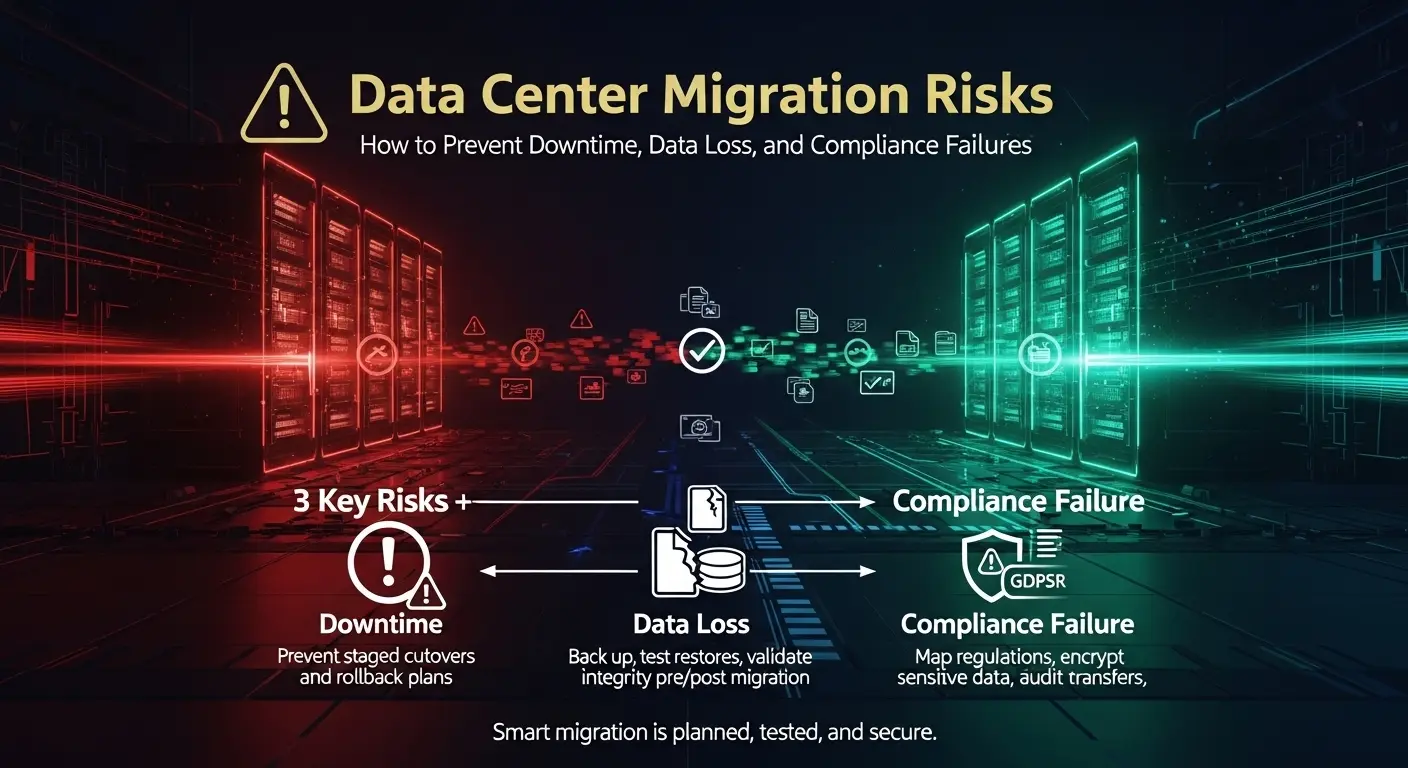
Data Center Migration Risks: How to Prevent Downtime, Data Loss, and Compliance Failures
Data center migrations look straightforward on paper: move systems, cut over, and move on. In reality, they’re moments of exposure. The risk isn’t only in the destination architecture—it spikes when systems are disturbed, dependencies surface late, and data-bearing assets are in motion. That’s when downtime, data loss, security gaps, and cost overruns happen.
This guide is built from deep competitor research and fills the gaps most articles miss: early warning signs, practical controls, chain-of-custody discipline, and evidence-based acceptance criteria you can actually use.
Quick Risk Summary Table
| Data center migration risk | What causes it | Early warning signs | Best prevention control |
| Unplanned downtime & disruption | Wrong cutover sequence, network changes, missed dependencies | Cutover tasks slipping, unknown “critical” services discovered late | Rehearsed cutover runbook + go/no-go gates + rollback triggers |
| Data loss or corruption | Interrupted transfers, incomplete backups, inconsistent sync | Restore tests not done, last-minute “final sync” changes | Backup + restore test + checksums/hash validation |
| Undocumented dependencies | Legacy integrations, hard-coded IPs, hidden schedulers/license servers | “It should work” assumptions, missing owners, unclear traffic flows | Dependency mapping + operator workshops + validation tests |
| Security breaches | Temporary access expansion, rushed configs, weak secrets hygiene | Shared accounts, default configs, missing logs | Least privilege + key rotation + secure transfer methods |
| Compliance failures | Data residency shifts, broken audit trails, improper sanitization | No compliance sign-off, unclear data location, missing evidence | Compliance requirements mapped to controls + evidence pack |
| Performance/SLA degradation | Latency changes, IOPS mismatch, load balancer drift | User complaints, higher error rates, slow DB queries | Baseline before move + load testing + compare metrics post-cutover |
| Cost overruns | Incomplete inventory, extended parallel run, vendor surprises | Scope creep, repeated changes, long stabilization | Contingency budget + strict scope control + phased waves |
| Physical handling errors | Bad labeling, shock damage, improper packing/staging | Asset list conflicts, missing gear, delayed receiving | Asset tagging + transport SOP + verified receipt checks |
| Chain-of-custody breaks | Untracked handoffs, unsecured staging, missing wipe proof | “Who had it?” questions, missing timestamps, no certificates | Custody logs + seals + verified sanitization/destruction evidence |
What Counts as Data Center Migration
A data center migration moves infrastructure, applications, and data from one environment to another—on-prem to a new site, to colocation, to cloud, or to hybrid. A data center relocation specifically refers to the physical movement of equipment from one facility to another. Many projects involve both, and that’s when risk multiplies.
Common triggers include cost reduction, consolidation, capacity growth, performance needs (latency), end-of-life hardware, security/compliance requirements, and business continuity objectives.
The 12 Most Common Data Center Migration Risks (Causes, Warning Signs, Mitigation)
1) Downtime and Business Disruption
Root cause
Downtime most often occurs when systems are migrated in the wrong sequence, network paths change without full impact analysis, or “supporting” services—such as DNS, authentication, time services, schedulers, or messaging queues—are excluded from the cutover scope. These failures are rarely dramatic at first but compound quickly.
Business impact
Service outages, revenue loss, SLA breaches, failed transactions, and erosion of customer trust. In regulated or high-traffic environments, even short outages can trigger contractual penalties or regulatory scrutiny.
Early warning signals
- Cutover steps are repeatedly revised late in the project
- Ownership of cutover tasks is unclear or shared
- New dependencies are discovered during the final week
- Critical services are described as “low risk” without validation
Mitigation controls
Use wave-based migration planning with clearly sequenced dependencies. Rehearse cutover in a staging environment that mirrors production behavior. Enforce formal go / no-go gates tied to objective readiness criteria and require a tested rollback plan before execution.
2) Data Loss or Data Corruption
Root cause
Data loss typically results from interrupted transfers, mismatched storage semantics, inconsistent formats, or backups that were never validated through restoration. The most common failure is assuming backups are sufficient without proving they are recoverable.
Business impact
Permanent data loss, prolonged reconciliation efforts, customer impact, regulatory exposure, and audit findings. In SaaS and financial systems, even small gaps in data integrity can invalidate reporting or customer records.
Early warning signals
- “Backups exist” but no restore evidence is available
- Recovery Point Objective (RPO) and Recovery Time Objective (RTO) are undefined
- Final synchronization window is vague or unplanned
- Data freeze strategy is unclear or disputed
Mitigation controls
Perform full backups immediately before migration. Execute restore testing in advance and validate integrity using checksums or hash comparisons. Define a clear data freeze and final sync strategy aligned to RPO/RTO requirements.
3) Undocumented Dependencies (The Silent Failure Mode)
Root cause
Long-running environments accumulate hidden dependencies over time: shared databases, authentication services, schedulers, license servers, batch scripts, and legacy integrations. Many are undocumented or known only by individuals who “keep things running.”
Business impact
Partial outages that appear random, broken batch jobs, failed reports, authentication issues, and degraded services that escape immediate detection but undermine confidence and operations.
Early warning signals
- Knowledge concentrated with a single individual (“only Bob knows”)
- Architecture diagrams do not match observed behavior
- Unexpected ports, calls, or services appear in logs late in testing
- Repeated “that shouldn’t depend on that” discoveries
Mitigation controls
Combine automated discovery tools with structured workshops involving operators and application owners. Validate dependency maps through testing and controlled shutdowns. Treat dependency mapping as an operational discipline, not a one-time technical exercise.
4) Security Breaches During Transition
Root cause
During migration, teams often relax controls to move faster—expanding access, reusing credentials, skipping hardening steps, or deploying systems with insecure defaults. Temporary exceptions frequently become permanent vulnerabilities.
Business impact
Unauthorized access, data exposure, active security incidents during migration, reputational damage, and post-migration audit findings that are difficult to remediate retroactively.
Early warning signals
- Shared or generic administrator accounts
- Missing or inconsistent MFA enforcement
- Firewall rules differ between old and new environments without review
- Limited logging or monitoring during transition
Mitigation controls
Enforce least-privilege access, rotate keys and secrets, encrypt all data transfers, and require formal security sign-off before cutover. Treat migration windows as high-risk periods, not exceptions to policy.
5) Compliance Failures and Audit Exposure
Root cause
Compliance breaks occur when data residency changes are not formally approved, audit trails are disrupted during migration, retention policies are not re-applied in the target environment, or proof of sanitization is missing for decommissioned assets. These gaps usually stem from treating compliance as a post-migration task rather than a migration control.
Business impact
Regulatory penalties, failed audits, legal exposure, forced remediation programs, and delayed certifications. In regulated industries, compliance failures can outweigh the technical success of the migration itself.
Early warning signals
- No migration-specific compliance checklist
- Unclear answers to “where does this data live now?”
- Sanitization or destruction handled informally
- Compliance sign-off deferred until after go-live
Mitigation controls
Translate regulatory obligations into explicit migration controls covering access, logging, data residency, retention, and sanitization. Require a documented evidence pack—including approvals, logs, and certificates—before declaring migration complete.
6) Performance Degradation, Latency, and SLA Erosion
Root cause
Performance issues arise when new network paths introduce latency, storage tiers fail to meet IOPS requirements, load balancer configurations drift from design, or capacity planning assumes ideal conditions. These risks are amplified when performance is validated only functionally, not under load.
Business impact
Slow user experience, missed batch windows, degraded application responsiveness, SLA violations, and customer dissatisfaction—often surfacing after go-live when rollback is no longer practical.
Early warning signals
- No pre-migration performance baselines
- Load testing skipped or minimized
- Assumptions based on “it worked before”
- Performance ownership unclear during stabilization
Mitigation controls
Capture baseline performance metrics before migration. Execute load and stress tests aligned to real usage patterns. Define service-level objectives (SLOs) and actively compare post-migration metrics during stabilization to confirm parity or improvement.
7) Cost Overruns and Financial Drift
Root cause
Cost overruns are driven by incomplete asset inventories, underestimated labor effort, extended parallel operations, unexpected vendor charges, and rework caused by late-discovered dependencies. Financial risk increases when scope changes are absorbed informally.
Business impact
Budget overruns, delayed strategic initiatives, reduced return on investment, and executive loss of confidence in the migration program.
Early warning signals
- Migration waves repeatedly replanned
- Stabilization periods extending beyond estimates
- Unplanned vendor fees or circuit costs
- Change requests approved without cost impact analysis
Mitigation controls
Maintain a defined contingency reserve. Lock scope at the wave level and manage changes through formal governance with risk and cost scoring. Track actuals versus forecast continuously and escalate variances early.
8) Inadequate Testing (Planning’s Primary Point of Failure)
Root cause
Testing fails when rehearsals are skipped to meet deadlines, staging environments do not accurately mirror production, or post-migration validation is treated as optional rather than mandatory. Planning without proof turns assumptions into outages.
Business impact
Defects surface only under real production load, extending outages, triggering emergency rollbacks, and eroding confidence in the migration program. Recovery becomes reactive instead of controlled.
Early warning signals
- Testing scope reduced “to hit the date”
- No formal user acceptance testing (UAT) plan
- Disaster recovery (DR) restores never executed
- Acceptance criteria undefined or informal
Mitigation controls
Rehearse the full cutover runbook end to end. Validate backups through restore testing. Execute functional, performance, and UAT checks against defined acceptance criteria before approving production cutover.
9) Weak Project Management and Overtaxed Change Capacity
Root cause
Data center migrations multiply change volume while spreading accountability across teams. Without unified ownership, clear decision authority, and disciplined communication, coordination breaks down under pressure.
Business impact
Missed dependencies, conflicting changes, delayed execution, and a higher error rate—often culminating in avoidable outages and loss of stakeholder trust.
Early warning signals
- Multiple “sources of truth” for status and plans
- Tasks stalled pending decisions or approvals
- Stakeholders surprised by outages or timing
- Escalations triggered too late to prevent impact
Mitigation controls
Establish a clear RACI model. Maintain a single authoritative runbook. Enforce change freezes and blackout windows. Operate a war-room with defined go/no-go authority and escalation paths.
10) Environment Compatibility and Long-Tail Systems
Root cause
Legacy systems often depend on specific operating systems, firmware, hardware configurations, or licensing models. Forcing modernization solely to meet migration timelines compounds risk by combining infrastructure change with application change.
Business impact
Critical systems fail outright or become unstable post-migration, leading to unexpected downtime, emergency rollbacks, and prolonged stabilization periods.
Early warning signals
- Unclear vendor support statements
- “Special” hardware or licensing requirements
- Dependencies tied to deprecated platforms
- Pressure to modernize without impact analysis
Mitigation controls
Create a compatibility matrix covering OS, hardware, firmware, and licensing. Allow controlled carve-outs such as temporary hosting, segmentation, or delayed retirement. Sequence change deliberately—do not compress it.
11) Physical Handling Errors During Relocation (Operational Risk)
Root cause
Physical relocation introduces risk when asset labeling is inconsistent, packing standards vary, staging areas are unsecured, or transport procedures are informal. Even minor handling lapses—shock, vibration, static exposure, or mixed asset loads—can cascade into major failures.
Business impact
Damaged hardware, delayed cutovers, extended outages, emergency replacements, and potential data exposure. Physical errors often surface late, when rollback options are limited.
Early warning signals
- CMDB or asset inventory does not reconcile with rack reality
- Inconsistent or duplicate asset tags
- Receiving teams unprepared or missing intake checklists
- Ad hoc packing or third-party handling without SOPs
Mitigation controls
Standardize asset tagging and labeling. Reconcile inventory before removal. Enforce transport SOPs (packing, shock protection, chain separation). Perform verified receipt checks at destination, including condition verification and inventory sign-off before power-up.
12) Chain of Custody Breaks (High-Impact, High-Scrutiny Risk)
Root cause
Chain-of-custody failures occur when data-bearing assets move without documented handoffs, secure staging, or verified sanitization or destruction. Risk peaks during physical transition and decommissioning, when accountability becomes fragmented across teams and vendors.
Business impact
Audit failure, regulatory exposure, breach investigations, legal liability, and reputational damage. Unlike technical issues, custody gaps cannot be remediated after the fact if evidence is missing.
Early warning signals
- No authoritative custody log
- Unclear answers to “who had it, when, and where”
- Missing or incomplete wipe/destruction certificates
- Assets staged in unsecured or shared areas
Mitigation controls
Maintain a continuous chain-of-custody log capturing asset ID, seal number, custodian, timestamps, locations, and signatures. Enforce secure staging and controlled access. Collect and retain verified sanitization or destruction certificates aligned with regulatory requirements.
Data Center Migration Risk Assessment Framework
Build a Risk Register That Teams Actually Use
Most data center migrations fail not because risks are unknown, but because they are not owned, not measured, and not proven as controlled. A practical data center migration risk assessment must produce a living risk register—one that assigns accountability, defines mitigation controls, and requires objective evidence before progress is approved.
Unlike generic risk lists, an enterprise-grade risk register is used before, during, and after migration events. It becomes the single source of truth for decision-making, escalation, and audit defense.
Core Risk Register Structure (Non-Negotiable Fields)
Every migration risk must be documented using the following structure:
- Risk – Clear, specific description of the failure scenario
- Likelihood – Probability of occurrence (Low / Medium / High)
- Impact – Business, security, or compliance impact if realized
- Owner – Named individual accountable for control execution
- Mitigation Control – Concrete action that reduces likelihood or impact
- Evidence / Exit Criteria – Verifiable proof that the control is effective
If any field is missing, the risk is not controlled—only acknowledged.
Enterprise Risk Register Example (Migration-Critical Risks)
| Risk | Likelihood | Impact | Owner | Mitigation Control | Evidence / Exit Criteria |
| Unplanned downtime | Medium | Ψηλά | Infrastructure Lead | Cutover rehearsal + documented rollback plan | RTO achieved in rehearsal; rollback executed successfully in test |
| Data loss or corruption | Low / Medium | Ψηλά | Data Platform Lead | Backup strategy + restore testing + integrity checks | Restore completed; checksum/hash validation passed |
| Compliance failure | Low / Medium | Ψηλά | Compliance / GRC Lead | Regulatory controls mapped to migration steps | Signed evidence pack; logs retained and reviewed |
| Chain-of-custody break | Χαμηλός | Ψηλά | Operations / Facilities Lead | Asset custody logging + physical seals | Complete custody log; verified wipe/destruction certificates |
Why This Works (And Competitors Fall Short)
Most competitor content stops at identifying risks. Enterprise environments require more:
- Ιδιοκτησία ensures risks are acted on, not debated
- Controls convert risk awareness into operational safety
- Evidence transforms assumptions into defensible proof
- Exit criteria prevent premature cutover or project closure
This evidence-based approach aligns with how auditors, regulators, and incident response teams evaluate migration outcomes. It is also the primary reason migrations fail after appearing successful—because proof was never collected.
How to Use the Risk Register During Migration
- Before cutover: No risk with “High impact” proceeds without evidence
- During execution: Owners report status against exit criteria, not opinions
- After migration: The register becomes part of the audit and compliance record
Risk registers that are not reviewed in go/no-go meetings are documentation artifacts—not control mechanisms.
Governing Principle
This single rule distinguishes enterprise-grade migration programs from checklist-driven projects. It is also the foundation for migrations that withstand audits, incident reviews, and executive scrutiny months or years later.
Where Risk Spikes in the Data Center Migration Lifecycle
Data center migration risk is not evenly distributed. It concentrates at specific phases where visibility drops, assumptions are tested, and actions become hard to reverse. Understanding where και why risk spikes allows enterprises to apply controls before failures surface in production, audits, or customer impact.
Phase 1: Discovery — Where Hidden Risk Is Created
Primary objective: Establish a complete, verifiable understanding of what exists and how systems actually operate.
This phase determines whether the migration will succeed or fail later. Most large-scale migration incidents trace back to incomplete discovery, not execution errors. The risk here is latent—issues are invisible but embedded into the plan.
Key risk drivers
- Incomplete asset inventories (hardware, VMs, applications, data stores)
- Undocumented dependencies (authentication services, schedulers, license servers, integrations)
- Unknown data sensitivity or regulatory scope
- Missing ownership for legacy or shared systems
Enterprise-grade deliverables
- Authoritative asset inventory (physical and virtual)
- Dependency maps validated with operators, not just tools
- Application criticality and business impact ratings
- Named technical and business owners for every system
Failure signal
If discovery relies only on diagrams, CMDB exports, or assumptions, risk has already entered the project.
Phase 2: Planning — Where Risk Is Locked Into the Timeline
Primary objective: Convert discovery data into a migration strategy that minimizes business, security, and compliance exposure.
Planning is where organizations unintentionally encode risk into schedules and cutover designs. Over-optimistic timelines and poorly sequenced moves amplify downstream failures.
Key risk drivers
- Wave plans that ignore dependency order
- Cutovers scheduled too close to peak business periods
- No defined rollback thresholds
- Security and compliance treated as post-migration tasks
Enterprise-grade deliverables
- Wave-based migration plan aligned to dependency order
- Detailed cutover plan with timing, owners, and decision gates
- Risk register with likelihood, impact, owner, and mitigation
- Stakeholder communication and escalation plan
Failure signal
If success is defined only as “finishing the move on time,” the plan is incomplete.
Phase 3: Testing & Rehearsal — Where Risk Is Either Reduced or Amplified
Primary objective: Prove that the migration plan works before production systems are touched.
Testing is not about functionality alone—it validates assumptions made during discovery and planning. Skipping or compressing this phase transfers risk directly into cutover.
Key risk drivers
- No parity between staging and production
- Backups tested for existence, not restoration
- No performance baselines for comparison
- Rehearsals skipped due to schedule pressure
Enterprise-grade deliverables
- Staging environment with meaningful production parity
- Verified backup and restore tests
- Pre-migration performance and latency baselines
- Rehearsed cutover runbooks with measured timings
Failure signal
If testing focuses only on “does it start,” performance, data integrity, and recovery risk remain unresolved.
Phase 4: Cutover Execution — Where Risk Becomes Incident
Primary objective: Execute the migration within a controlled window while preserving the ability to stop or reverse.
This is the highest-risk operational phase. Decisions made here are time-bound, high-pressure, and often irreversible. Small errors can cascade rapidly.
Key risk drivers
- Deviations from the runbook under pressure
- Inadequate decision authority in the war room
- Poor real-time visibility into progress
- Physical asset movement without strict tracking
Enterprise-grade deliverables
- Timestamped runbook execution timeline
- War-room structure with defined authority
- Go/no-go decision gates tied to objective criteria
- Rollback triggers with clear ownership
Failure signal
If rollback criteria are unclear or politically difficult to invoke, the organization is exposed.
Phase 5: Validation & Stabilization — Where “Late Risk” Emerges
Primary objective: Confirm that systems are stable, compliant, and performing as expected under real-world conditions.
Many migrations appear successful at cutover but fail weeks or months later during audits, peak load, or incident reviews. This phase protects against delayed impact.
Key risk drivers
- No post-migration monitoring window
- Missing audit and compliance evidence
- Unvalidated performance under real usage
- Decommissioning performed without custody controls
Enterprise-grade deliverables
- Continuous monitoring and SLA validation
- Performance comparison against pre-migration baselines
- Compliance and audit evidence pack
- Verified decommissioning and data sanitization records
Failure signal
If the project is closed immediately after cutover, unresolved risk is almost guaranteed.
Critical Insight: Where Risk Peaks
While risk accumulates across all phases, it peaks during cutover and physical transition/decommissioning. At this point:
- Systems are live but unstable
- Physical assets are in motion
- Chain-of-custody must be provable
- Errors are expensive or irreversible
Enterprise-grade migrations focus less on speed and more on control, traceability, and evidence at these moments. That discipline—not tools or architecture alone—is what separates stable migrations from costly failures.
Controls That Reduce Risk in Real Projects
Planning controls
- Lock scope per wave (avoid “everything at once”)
- Define blackout windows and business constraints
- Assign owners (RACI) and decision authority
- Maintain a single source of truth for status
Technical controls
- Backups + restore testing (not just “backup exists”)
- Secure transfer methods + encryption in transit
- Baseline performance before migration
- Confirm capacity: CPU/RAM/IOPS/bandwidth needs
Execution controls
- Cutover runbook with timestamps and dependencies
- Go/no-go gates and rollback triggers
- Stakeholder communications cadence
- Post-migration validation checklist
Evidence-based acceptance criteria (what “done” means)
- RTO/RPO targets met and recorded
- Restore test passed with proof
- Performance baseline matched or improved
- Security and compliance sign-off completed
- Chain-of-custody logs complete (if physical assets moved)
Migration Strategy Decision Guide: Which Approach Is Lowest Risk?
| Approach | Risk profile | Best for |
| Lift-and-shift | Fast, but dependency risks remain | Time-limited moves, stable apps |
| Re-platform | Moderate risk, more change | Apps needing some modernization |
| Rebuild/Refactor | Highest change risk, long timelines | Strategic transformation, large benefits |
| Phased cutover | Lower operational risk, more coordination | Most enterprise migrations |
| Big-bang cutover | Highest outage risk | Small environments with low complexity |
Practical rule: if business continuity is critical, choose phased waves and rehearse.
Atal Networks
If your migration involves moving workloads to new infrastructure, stable, predictable hosting can reduce performance variability and simplify capacity planning. Learn more about Atal Networks and infrastructure options like αποκλειστικοί διακομιστές for consistent resource allocation.
FAQ: Data Center Migration Risks
What are the biggest data center migration risks?
The biggest risks are unplanned downtime, data loss or corruption, undocumented dependencies, security breaches, compliance failures, performance degradation, and cost overruns. Risk often peaks during cutover and physical transition because mistakes are hard to undo and visibility is reduced.
How do you prevent downtime during a data center migration?
Prevent downtime by sequencing migrations in waves, rehearsing cutover steps, and using go/no-go gates with rollback triggers. Dependency mapping is essential—many outages happen because a “small” service or integration wasn’t included in the plan.
What causes data loss during migration?
Data loss is usually caused by incomplete backup strategies, interrupted transfers, inconsistent sync windows, or untested restores. The safest approach is to validate backups with restore tests and verify integrity using checksums or hashes.
What is a data center migration risk assessment?
A risk assessment identifies migration threats, estimates likelihood and impact, assigns owners, and maps each risk to mitigation controls and evidence. The output should be a practical risk register, not a generic list, and it should define what proof is required before cutover.
Why do undocumented dependencies cause failures?
Because modern environments often rely on hidden services and integrations that aren’t captured in diagrams—like schedulers, authentication services, license servers, and legacy scripts. These dependencies often appear only when systems are disturbed, which is why migrations reveal problems late.
What causes compliance failures in data center migrations?
Compliance failures occur when data residency changes aren’t tracked, audit logs aren’t preserved, or decommissioned assets lack sanitization proof. A compliance-ready migration maps requirements to controls and collects an evidence pack with sign-offs.
How long does a data center migration take?
Timelines range from weeks to months (or longer) depending on scope, number of applications, testing depth, and whether physical relocation is involved. Phased migrations typically take longer but reduce disruption and recovery workload after cutover.
Conclusion
Data center migration risks are predictable—and that’s good news. Downtime, data loss, compliance failures, and cost overruns usually come from the same root causes: hidden dependencies, rushed planning, inadequate testing, weak coordination, and poor evidence. The safest migrations treat risk as a program: build a risk register with owners, rehearse cutover, maintain chain-of-custody discipline during physical transition, and define acceptance criteria you can prove. That’s how you move systems safely—and remain stable after the move.